Best Suitcase for International Travel: A Practical Comparison by Trip Type, Budget, and Durability
Travel Smart Jul 21, 2026 6 min read time

Best Suitcase for International Travel: A Practical Comparison by Trip Type, Budget, and Durability

Summary

Choosing the best suitcase for international travel matters more than most people realize, and the right answer changes completely depending on how long you're going, what surfaces you'll cross, and how many transport modes you'll use.

Introduction

Choosing the best suitcase for international travel matters more than most people realize, and the right answer changes completely depending on how long you’re going, what surfaces you’ll cross, and how many transport modes you’ll use. A four-wheel spinner that glides through Schiphol becomes a liability on Lisbon cobblestones. A budget bag that survives a weekend city break can fall apart on a layover in Hong Kong. The sections below work through the four decisions that actually matter: trip-length fit, price tier, damage resistance, and security, with real brand examples and test results at each step.

  • Trip length and terrain determine wheel type and shell material more than anything else.
  • Warranty quality varies enormously across price tiers, and exclusions matter as much as coverage.
  • Corners, wheels, and zippers fail first; knowing which brands reinforce them saves money long-term.
  • TSA locks are a baseline, not a guarantee, shell type and zipper quality matter just as much.
  • No single suitcase wins for all trips; the right bag matches your specific itinerary.

Weight, Distance, and Duration: Matching the Bag to the Trip

Most buyers pick a suitcase by size alone. That’s the wrong starting point. The more useful questions are: what surfaces will this bag cross, and how many times will someone lift it in and out of transport?

Rick Steves, who has spent decades traveling Europe with carry-on discipline, makes the trade-off concrete: four-wheel spinners are effortless on flat airport floors but “utterly hobbled by cobbles.” He also notes that hard-sided models run a pound or two heavier than soft-sided equivalents, a real cost when airlines weigh every gram.

Short trips (1, 3 days, airport-to-hotel)

A four-wheel spinner carry-on is the right tool here. You stay on smooth surfaces, you don’t check a bag, and maneuverability matters more than ruggedness. Consumer Reports flags one trap: expanding zippers can push bags over airline weight limits, so check that feature before you buy.

Medium trips (4, 10 days, mixed transport)

A soft-sided rolling bag or a hybrid works better. You gain flexibility, soft sides compress into overhead bins and absorb irregular shapes. The weight saving over a hard shell also matters when you’re checking a bag on a budget carrier.

Long trips and multi-country itineraries (10+ days)

This is where spinners lose. A two-wheel rolling bag handles uneven terrain far better, and a bag with backpack straps, like the Stubble & Co design highlighted in a hands-on ten-model comparison on YouTube, lets you navigate train station stairs without wrenching your shoulder.
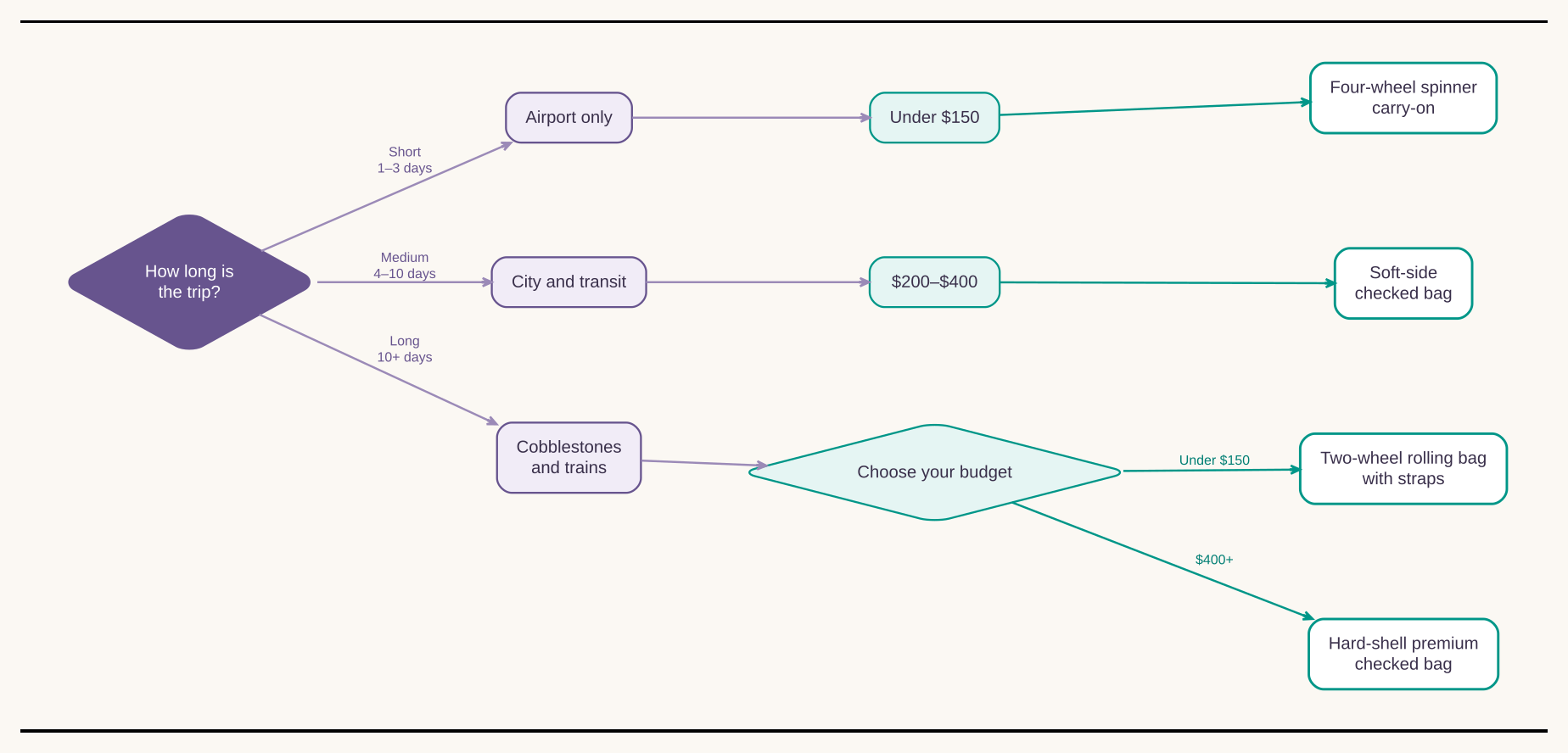
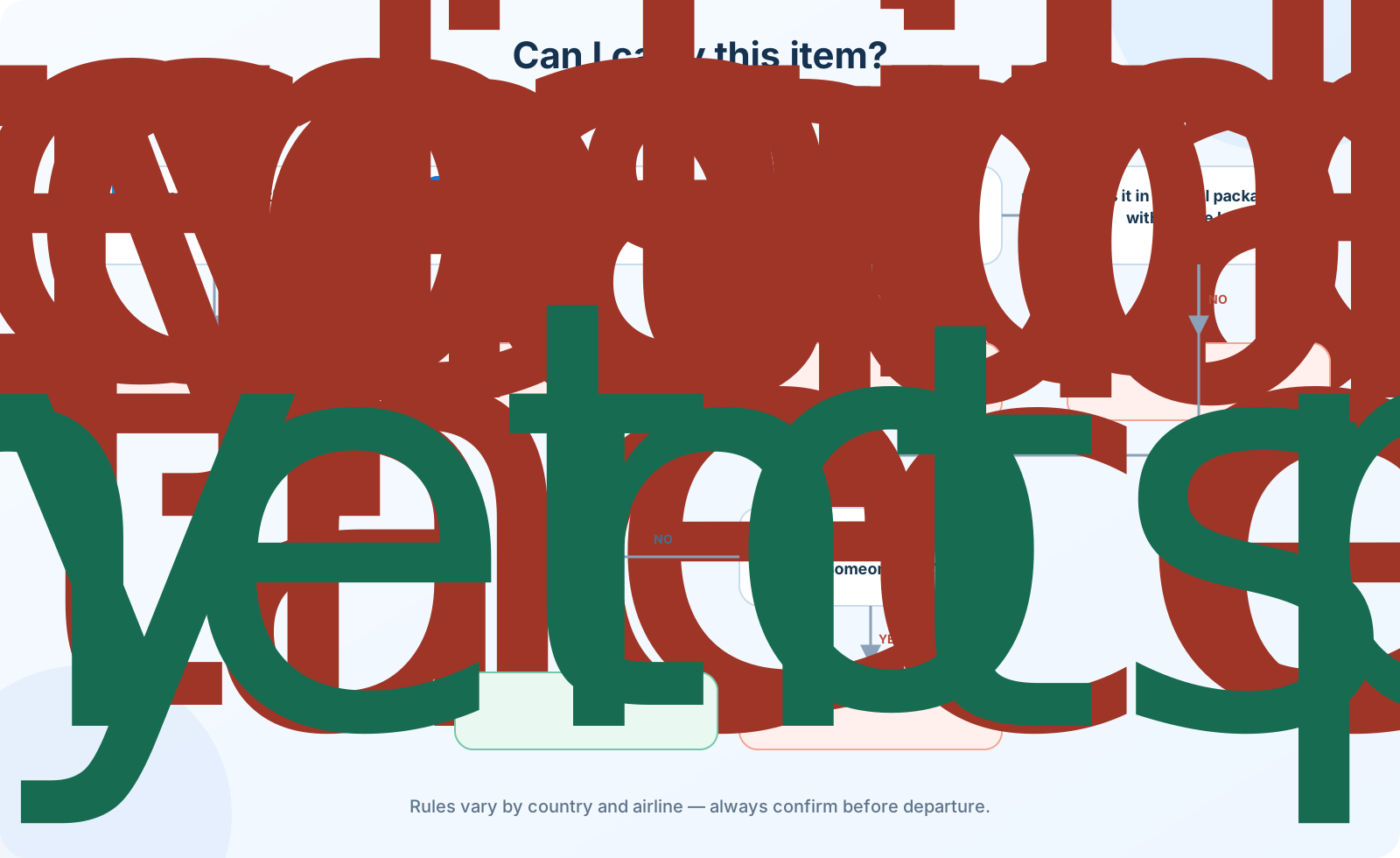
Decision flowchart for finding the best suitcase for yourself based on your need.

Price Comparison: What You Actually Get at Each Budget Tier

A travel gear reviewer who tested ten premium suitcases side by side put the budget risk plainly: “You can go on Amazon, get one for 85 or 90 bucks and it’ll last you a little while. But if the zipper breaks on a layover in Hong Kong on your way to Sri Lanka, you are screwed, you’re going to be paying more because you’ll have to buy luggage right there.” That’s not a hypothetical. It’s the real cost of a cheap zipper on the wrong trip.

Budget tier ($85, $100): Amazon generics and no-name brands. Functional for occasional short trips. No meaningful warranty. The YouTube comparison is candid: the savings evaporate the moment something breaks abroad.

Mid-range ($200, $400): This is where quality becomes consistent. NYT Wirecutter calls the Travelpro Platinum Elite “the bag to compare others against”, durable, well-organized, with a carrier-damage warranty if you register within 120 days of purchase. Away The Medium also sits in this tier as Wirecutter’s top hard-sided pick.

Premium ($400, $900): Briggs & Riley leads here. Forbes Vetted and Wirecutter both cite it as the upgrade pick. It’s one of the only brands offering a true lifetime warranty that covers functional damage, not just manufacturing defects.

Luxury ($700+): The Rimowa Original uses an aluminum lock frame and 360-degree silent spinner wheels, with a lifetime warranty on functional damage. CN Traveller puts large check-in cases from £400 upward as a general benchmark, with the Louis Vuitton Horizon 50 starting at £2,380, an heirloom object, not a practical travel tool for most people.

What Actually Damages a Suitcase (and Which Materials Hold Up)

Voyage Luggage’s material breakdown is worth reading before you buy: corners take the first impact almost every time, so reinforced corners are a meaningful spec, not marketing copy. Wheels and zippers are the next failure points. YKK zippers are the industry benchmark for strength, generic alternatives are significantly easier to force or split. Dual-caster (double) spinner wheels distribute stress across more contact points than single-caster designs, which extends wheel life on rough surfaces.

Shell material is a genuine trade-off, not a ranking. Polycarbonate absorbs shock well and flexes under impact. Aluminum is rigid and heavy. Ballistic nylon resists abrasion but offers less protection for fragile contents.

Good Housekeeping’s testing lab drops luggage from three feet at multiple angles to simulate real baggage handling. In their tests, the Briggs & Riley Sympatico polycarbonate shell “resisted dents” and scored high on maneuverability. The Baseline Global Carry-On Spinner won their Travel Award twice. Those are lab-verified results, not brand claims.

One specific warning from Consumer Reports: expanding zippers are “potentially just one more thing to break.” If you use the expansion feature regularly, you’re adding stress to the zipper track on every trip.

Security: Locks, Shells, and What “Secure” Actually Means

CN Traveller states the baseline clearly: a TSA-approved lock lets airport security inspect your bag without cutting it open. All their top picks include one built in. But a TSA lock on a weak zipper is not real security, anyone with a ballpoint pen can pop a standard zipper closure in seconds.

This is where shell type and zipper quality matter more than the lock itself. Voyage Luggage notes that aluminum offers rigid security, while polycarbonate provides shock absorption but less resistance to forced entry. YKK zippers are substantially harder to compromise than generic alternatives.

At the premium end, Forbes Vetted highlights Rimowa’s aluminum lock frame as a genuine differentiator, it replaces the zipper closure entirely, which removes the most common vulnerability. Briggs & Riley uses a proprietary CX compression expansion system rather than a standard expanding zipper, which adds structural integrity. Travelpro and Away use standard TSA combination locks, which are adequate for most travelers but not equivalent to a frame lock.

Quick Brand Profiles: Who Makes What and for Whom

Brand / Model Price Tier Shell Material Wheel Type Warranty TSA Lock
Travelpro Platinum Elite $200, $400 Soft (nylon) 4-wheel spinner Carrier-damage (120-day reg.) Yes
Away The Medium $200, $400 Polycarbonate 4-wheel spinner Limited lifetime Yes
Briggs & Riley Baseline $400, $900 Polycarbonate 4-wheel spinner True lifetime (functional) Yes
Rimowa Original $700+ Aluminum 4-wheel silent spinner Lifetime (functional) Aluminum frame lock
Samsonite (various) $100, $500 Polycarbonate / soft 4-wheel spinner Varies by model Yes (most models)
Pelican (hard case) $150, $400 Polypropylene 2-wheel Lifetime Lockable latches

Samsonite is Good Housekeeping’s top overall brand pick for consistent durability across a wide price range. Travelpro is the airline crew standard, built for daily abuse. Briggs & Riley and Rimowa are the upgrade picks when longevity over many years justifies the upfront cost. Pelican is the right answer for fragile or high-value contents, the YouTube reviewer describes it as “bombproof,” which is accurate for its category.

If Your Suitcase Is Also Doing a Job: Carrying Goods for Others

Some travelers use spare luggage capacity to carry goods for senders as a way to offset trip costs, a model sometimes called peer-to-peer courier shipping. If you’re doing this, suitcase choice has an extra layer: weight budget becomes critical (you need to know your bag’s empty weight precisely), durability matters more because you’re responsible for someone else’s goods, and hard-shell models offer better protection for packaged items. The blog post How to Make Money with a Suitcase covers the mechanics and platforms in detail. SendByPass is one platform in this space, connecting verified student travelers with SMEs who need cross-border shipping, but several platforms operate in this category, and many travelers already do informal arrangements without any platform at all.

The Honest Decision Matrix

No suitcase is best for every trip. The practical shortcut is to map your trip profile to the right tier:

  • Short, airport-heavy trip on a tight budget: four-wheel soft-side carry-on, $100, $200, TSA lock, skip the hard shell.
  • One to two weeks, mixed cities and transit: Travelpro Platinum Elite or Away The Medium, mid-range, proven durability, real warranty.
  • Frequent long-haul travel or multi-year use: Briggs & Riley. The lifetime warranty pays for itself after one repair you won’t pay for.
  • Fragile or high-value contents, adventure travel: Pelican hard case.
  • Luxury purchase you’ll keep for a decade: Rimowa, with the aluminum frame lock as a genuine security upgrade over zippers.

The most expensive bag is not the right bag for every trip. The right bag is the one that matches the terrain, the duration, and the airline rules you’ll actually face.

Frequently Asked Questions

What is the most durable suitcase for international travel?

Briggs & Riley and Rimowa consistently top durability tests and offer genuine lifetime warranties covering functional damage. Good Housekeeping’s lab drop tests found the Briggs & Riley Sympatico polycarbonate shell resisted dents under repeated impact. Samsonite is the most consistently durable brand across a wider price range.

Hard shell or soft shell, which is better for checked luggage?

Hard shells protect fragile contents better and resist compression from other bags. Soft shells are lighter, flex into overhead bins, and handle irregular packing better. Hard shells run one to two pounds heavier than soft-sided equivalents at the same size, which matters on budget airlines with strict weight limits.

What size suitcase do I need for a two-week international trip?

A medium checked bag (roughly 25, 26 inches) handles two weeks for most travelers. CN Traveller benchmarks medium check-in cases from around £300. If you’re moving between many destinations by train or bus, consider whether a slightly smaller bag with better mobility is worth the packing discipline.

Are TSA locks worth it for international travel?

TSA-approved locks let security inspect your bag without cutting it open, which prevents damage. They are worth having as a baseline. But a TSA lock on a weak zipper offers limited real security, zipper quality (look for YKK) and shell rigidity matter as much as the lock itself.

What is the best budget suitcase for international travel?

At the budget end, Samsonite offers the most consistent quality-to-price ratio and is available across a wide range. Generic Amazon options work for occasional short trips but carry real risk on long-haul itineraries, a broken zipper mid-trip means buying a replacement at inflated local prices.

How heavy should a checked suitcase be when empty?

Most airlines allow 23kg (50 lbs) for economy checked luggage. An empty medium hard-shell suitcase typically weighs 4, 6 kg, leaving 17, 19 kg for contents. Soft-sided bags save one to two pounds over hard-shell equivalents at the same size, which is meaningful if you pack heavy.

Sources

share

You may also like.

Discover insights, tips, and inspiration
How to Check if an Item Is Legal to Bring Across Borders
Int. travel regulations Jul 20, 2026 6 min read time

How to Check if an Item Is Legal to Bring Across Borders

Summary

Harding Bush, a former Navy SEAL and Operations Manager at Global Rescue, was nearly detained in Jordan after customs officers found two-way radios in his carry-on.

Introduction

Harding Bush, a former Navy SEAL and Operations Manager at Global Rescue, was nearly detained in Jordan after customs officers found two-way radios in his carry-on. The radios were perfectly legal at home. In Jordan, possessing them without authorization is generally illegal. The only reason he avoided jail was a business card from the King’s security detail. Most travelers are not that lucky. Knowing how to check if an item is legal to bring across borders is not a bureaucratic formality, it is the difference between a smooth trip and a very bad day.

  • Prohibited and restricted are not the same thing, the distinction matters enormously at the border.
  • Several everyday items (protein powder, pork products, certain medications) routinely trigger customs delays or confiscation.
  • Ignorance is not a legal defense once you cross a border.
  • You can verify most items before you ever reach the airport, using free official sources.
  • Carrying a package for someone else puts you legally on the hook if the contents are illegal.

The Most Reliable Sources to Check Before You Pack

There is no single global database for customs rules. Each country sets its own laws, and they change. But several authoritative sources cover the most common routes and item categories.

Source What it covers Best for How to access
CBP Know Before You Go Prohibited vs. restricted items, agricultural rules, civil penalties Travelers entering or leaving the US cbp.gov
U.S. State Dept Laws Abroad Items you cannot take out of other countries (gold, antiques, electronics) Americans traveling internationally travel.state.gov
Destination country embassy Country-specific rules for specific items Any traveler unsure about one specific item Search “[country] embassy [your city]”
Your airline Dangerous goods, battery rules, carry-on vs. checked restrictions Anyone flying with electronics, gases, or unusual items Airline website or customer service
IATA dangerous goods rules Flammable, explosive, toxic, and pressurized items Shippers and travelers with batteries, aerosols, or chemicals homeaffairs.gov.au links to IATA guidance

The prohibited vs. restricted distinction is the one most travelers miss. Prohibited means the law forbids it, full stop. Restricted means it is allowed, but only with the right permit, declaration, or documentation. Absinthe, for example, is restricted entering the US, not banned outright, but subject to specific rules. Haitian animal hide drums are restricted due to anthrax risk. The CBP prohibited and restricted items list walks through both categories item by item.

For EU and Netherlands-based travelers, the Dutch Douane (customs authority) website and the EU’s TARIC database are the equivalent go-to tools for verifying tariff codes and import restrictions on specific goods.

Can You Check an Item’s Eligibility Before You Reach the Gate?

Yes, and the earlier you check, the more options you have.

CBP recommends contacting them before your trip departs if you are uncertain about a specific item. Your airline is the next call. Australian Home Affairs advises checking with the airline before you arrive at the airport, and suggests packing uncertain items in checked baggage if the airline permits it.

One thing many travelers do not realize: the security screening officer has the final say, even if the airline already said yes. An officer can override the airline’s approval at the gate. That is not arbitrary, it reflects the fact that officers see the actual item, not a description of it.

If an item is flagged as “not acceptable for carriage” (meaning not illegal, just not permitted on that flight), it is generally returned to you. If it is restricted, it may be held pending paperwork or duty payment. If you have not yet cleared immigration, you may be able to return to the public area and mail the item to yourself, though this depends entirely on the airport layout.

Use this quick decision flow before you pack anything you are unsure about:

Decision flowchart for checking an item before flying: is it prohibited, restricted, does it contain lithium batteries or gas, is it in original packaging, and are you carrying it for someone else.
Pre-flight check: can I carry this item?

The Items Customs Officers Find Most Suspicious

Customs officers are pattern-recognition professionals. Certain items reliably attract attention, not always because they are illegal, but because they match the profile of things that often are.

Unlabeled powders and supplements are a consistent trigger. Travelers in Australia and the UAE have been held for hours while labs tested what turned out to be protein powder or vitamins. The problem is not the powder itself, it is the unlabeled bag. Keep supplements in their original sealed containers.

Medications without packaging are another common issue. In countries like Japan or the UAE, a pill organizer with no labels can trigger a lab test. Heart medication, thyroid pills, insulin, all can be flagged. Carry the original box and, for prescription drugs, a letter from your doctor.

Lithium batteries and electronics cause more delays than almost any other category. Non-removable batteries in checked luggage, tablets packed in suitcases, heated vests with battery packs still connected, all set off alarms. A buzzing electric razor or toothbrush in a checked bag has caused bags to be torn apart on suspicion of an improvised device. Switch everything off and, where possible, carry batteries in your hand luggage.

Even novelty items are not safe. TSA found grenade-shaped bottle openers in checked luggage at Newark Liberty Airport. They were intended as groomsmen gifts. The shape was enough to trigger a full bag search.

Items That Are Surprisingly Illegal on Specific Routes

This is where travelers get caught most often, not through intent, but through assumption. “It’s legal at home” is not a customs argument.

CBD and cannabis products are the clearest modern example. Even products marketed as THC-free can be treated as controlled substances across much of Asia and the Middle East. Advanced screening can detect cannabinoids. “I didn’t know” does not move the needle at the border.

Camouflage clothing is illegal in several Caribbean countries. Chewing gum is banned in Singapore. These are not urban legends, Global Rescue documents both as real enforcement situations.

Food categories catch people constantly. A woman crossing from the US into Mexico was stopped with 227 pounds of bologna hidden under her rear car seats. Importing pork from the US into Mexico is not permitted. She was fined $1,000. The lesson is not about the quantity, it is that “common food” is not a safe assumption at any border.

Other items worth knowing about, drawn from official sources:

  • Antiques and cultural artifacts: a 3,000-year-old Egyptian sarcophagus was flagged at Miami International after being shipped from a Spanish art gallery. ICE and CBP traced the illegal antiquities paperwork. The case ended in seizure.
  • Butane curling irons with spare refill cartridges: the iron itself may be allowed; the spare butane cartridge (a pressurized gas) is confiscated immediately.
  • Electronic equipment not declared on arrival: if you bring a laptop into a country and do not declare it, you may not be permitted to take it back out.
  • Large amounts of cash or gold: subject to declaration thresholds in most countries, with seizure as the penalty for non-disclosure.

What Happens If You Are Caught With an Illegal Item You Did Not Know About

The short answer: the law does not require that you knew. Global Rescue’s security experts are direct about this, you are bound by local laws the moment you cross a border, regardless of intent. The U.S. State Department says the same.

Outcomes range from confiscation (the best case) through fines, detention, expulsion, and in serious cases, criminal prosecution. For undeclared agricultural products, CBP civil penalties run up to $1,000 per first-time offense for non-commercial quantities. Commercial violations are assessed at significantly higher rates.

The legal nuance matters here. Criminal liability generally requires both the act and knowledge of it (what lawyers call actus reus and mens rea). In practice, if a carrier genuinely had no knowledge of what they were carrying, prosecution is less likely, but you may still spend time and money arguing the case. Real incidents have involved older travelers arrested at customs for drugs placed in their luggage by someone they trusted.

The critical question customs officers ask: “Are you carrying anything for anyone else?” If the answer is yes, you need to know what is in that package.

A Note on Peer-to-Peer Shipping and Compliance

If you carry packages across borders for others, whether informally or through a platform, the customs question above is not hypothetical. It applies to you directly. The “I didn’t know what was inside” defense is weaker the more you were compensated, and weaker still if the circumstances were unusual.

Some travelers and small businesses already manage this through conventional carriers (DHL, FedEx, PostNL) or freight forwarders, which handle documentation and compliance on their behalf. Others use informal arrangements, which shift all legal responsibility to the individual carrier.

One platform that addresses this specifically is SendByPass, a peer-to-peer shipping marketplace that connects senders with verified student travelers carrying spare luggage capacity. Its compliance engine includes KYC identity checks, fraud screening, and regulatory guidance, so both the sender and the traveler know what is in the package and that it has been vetted before the trip. It is one option among several, and many travelers and businesses already handle cross-border shipping perfectly well without it. But for anyone new to carrying packages for others, understanding how to legally carry cargo on a flight is the necessary starting point before accepting any package from a third party.

The single most useful habit: check the destination country’s official customs authority and your airline before you pack, not after. Keep items in original packaging with visible labels. Declare anything you are unsure about, declaration is almost always the safer outcome compared to concealment. And if someone asks you to carry something for them, know what it is before you say yes.

Frequently Asked Questions

How do I check if an item is legal to bring across borders before I travel?

Start with the official customs authority of your destination country. For US-bound travel, the CBP’s Prohibited and Restricted Items page covers most categories. For other destinations, the U.S. State Department’s Laws Abroad page and the destination country’s embassy are the most reliable sources. Your airline can also confirm rules for specific items, especially electronics and dangerous goods.

What is the difference between a prohibited item and a restricted item at customs?

A prohibited item is forbidden by law, you cannot bring it in under any circumstances. A restricted item is allowed, but only with the correct permit, declaration, or documentation. Missing that paperwork turns a restricted item into a customs violation at the border.

Can I be held legally responsible for an item I did not know was illegal?

Yes, in most jurisdictions. Ignorance of local law is not a recognized defense once you cross a border. Criminal prosecution typically requires proof of knowledge, but you can still face confiscation, fines, and detention while the matter is investigated. If you are carrying a package for someone else and do not know its contents, your legal exposure increases significantly.

What items are most commonly confiscated at customs?

Unlabeled powders and supplements, medications without original packaging, lithium batteries in checked luggage, food products (especially meat and agricultural items), and items that resemble weapons in shape, even novelty items. Cultural artifacts and antiques without proper provenance documentation are also a frequent trigger for seizure.

What should I do if a customs officer flags an item I am carrying?

Stay calm and cooperate. If the item is “not acceptable for carriage” (not illegal, just not permitted on that specific flight), it will generally be returned to you. If it is restricted, it may be held pending paperwork or payment of duties. If you have not yet cleared immigration, you may be able to return to the public area and arrange to mail the item home, though this depends on the airport layout.

Are there items that are legal at home but illegal at my destination?

Many. CBD products are treated as controlled substances in parts of Asia and the Middle East. Camouflage clothing is illegal in several Caribbean countries. Chewing gum is banned in Singapore. Pork products face import restrictions in several countries. Over-the-counter medications that are freely available in one country can be prescription-only or banned in another. Always verify the specific rules for your destination, not just your country of origin.

Sources

share

You may also like.

Discover insights, tips, and inspiration
International Airports in the Netherlands: Passengers, Facilities, and How to Get to the City
Airports Jul 20, 2026 6 min read time

International Airports in the Netherlands: Passengers, Facilities, and How to Get to the City

Summary

The international airports in the Netherlands move more air passengers than almost any other country of comparable size in the world. In 2023, 71.3 million passengers traveled through Dutch airports, a 16% jump on 2022, across just five civil airports handling scheduled international traffic.

Introduction

The international airports in the Netherlands move more air passengers than almost any other country of comparable size in the world. In 2023, 71.3 million passengers traveled through Dutch airports, a 16% jump on 2022, across just five civil airports handling scheduled international traffic. The country is smaller than West Virginia, yet its aviation network connects to nearly every corner of the globe. This guide profiles each of the five airports with the same four questions: how many passengers, how many destinations, what facilities, and how far from the city center.

  • Amsterdam Schiphol is Europe’s third busiest airport by volume and the undisputed global hub.
  • Eindhoven is the Netherlands’ main low-cost gateway, handling around 7 million passengers in 2023.
  • Rotterdam The Hague serves the Randstad with holiday and European routes, now passing 2.4 million passengers annually.
  • Maastricht Aachen is primarily a cargo airport with limited but useful passenger routes for the south of the country.
  • Groningen Eelde is a small northeastern regional airport and home to the KLM Flight Academy.
  • Choosing the right airport depends on your route, budget, and where in the Netherlands you are headed.

Amsterdam Airport Schiphol (AMS)

  • 62 million passengers in 2023
  • #2 worldwide for global connectivity, behind Atlanta
  • 333 direct destinations

Those numbers are not just marketing. Schiphol’s connectivity ranking means that if you are flying from almost anywhere and need to reach almost anywhere else, a one-stop via Amsterdam is genuinely competitive with routing through Frankfurt or Paris. The airport served around 62 million passengers in 2023, still below the 72 million it handled before the pandemic, but firmly back as Europe’s third busiest by volume.

Schiphol is unusual in that it operates as a single passenger terminal divided into three departure halls. There is no inter-terminal shuttle. You clear security once and walk. That design keeps connection times short, which matters when you are transiting between a long-haul KLM flight and a regional hop. KLM and the SkyTeam alliance use Schiphol as their primary European hub, which concentrates a large number of connecting passengers in one place.

Getting to Amsterdam City

The airport sits 9 km southwest of Amsterdam city center. An NS intercity train runs directly from the station beneath the terminal to Amsterdam Centraal in roughly 15 minutes. The same rail network connects Schiphol to Utrecht, The Hague, Rotterdam, and Eindhoven without changing trains. Eurostar and Thalys services also stop here, making the airport a genuine multimodal hub rather than just an air node.

Cargo throughput reached 1.74 million tonnes in 2023, placing Schiphol fourth in Europe for freight. That volume is why the airport matters not just to travelers but to Dutch exporters, a point covered in more depth in the blog’s look at which Dutch SME products are best suited to cross-border shipping.

Eindhoven Airport (EIN)

Eindhoven is the Netherlands’ second largest airport, and it operates on a completely different logic from Schiphol. Around 7 million passengers used it in 2023. The airport grew out of a military base and now functions as the country’s main low-cost hub, served by carriers like Ryanair and Wizz Air across 82 destinations with 8 airlines.

The terminal is compact: ground level and one floor above, with car rental desks, a travel doctor, meditation areas, and a lounge. There is nothing overwhelming about it. For a traveler flying to Barcelona or Krakow on a budget, that simplicity is a feature. Eindhoven is about 130 km from Amsterdam, roughly a 90-minute drive, which makes it genuinely useful for passengers in the southern Netherlands but less practical as an Amsterdam alternative unless the fare gap is significant.

The city center is around 9 km from the terminal. Bus connections run regularly. Eindhoven also works well as an entry point for Den Bosch and Maastricht.

Rotterdam The Hague Airport (RTM)

Rotterdam The Hague sits between the two cities it serves, in South Holland. It handles over 2.4 million passengers annually as of 2025, with more than 52,000 take-offs and landings per year. The route map leans heavily toward holiday destinations: London City is the top destination, followed by Alicante, Malaga, and Faro. Airlines include British Airways, Transavia, TUI, Corendon, Pegasus, and SunExpress.

If you are connecting onward to London, the London Heathrow airport guide covers arrival logistics on the UK side. Rotterdam also sees Dutch government traffic given its proximity to The Hague, so the passenger mix is more varied than the holiday-heavy route list suggests.

Getting to the City

Bus 33 runs from the terminal to Rotterdam Centraal in about 30 minutes. From there, NS trains reach Amsterdam in another 30 minutes. The airport has one runway and one terminal, with parking within walking distance and extra assistance available through ground handler Aviapartner.

Maastricht Aachen Airport (MST)

Maastricht Aachen is the smallest of the five airports for passenger traffic, with roughly half a million passengers annually. Its real business is cargo: it ranks second in the Netherlands for cargo volume, behind Schiphol. Passenger routes are seasonal and change year to year, covering popular Dutch holiday destinations along with London, Berlin, and Munich.

The single terminal is uncrowded, which has its own appeal. A taxi to Maastricht city center takes about 15 minutes and costs around 30 euros. Public buses also run. From Amsterdam, the drive is roughly two hours. This airport makes most sense for travelers already in the south of Limburg province, or for cargo operators who need a less congested alternative to Schiphol.

Groningen Airport Eelde (GRQ)

Groningen Eelde is the Netherlands’ northeastern gateway. It sits near the village of Eelde in Drenthe province, close to Groningen city. The airport serves a mix of holidaymakers and business travelers and is the home base of the KLM Flight Academy, which gives it an unusual dual identity: part regional airport, part professional pilot training ground.

Scheduled passenger routes are limited. The airport is listed among the five civil airports with scheduled international service, but specific passenger counts and detailed facility data are not consistently published. For travelers in the north of the Netherlands, it offers a local departure option that avoids the three-hour round trip to Schiphol.

Side-by-Side: All Five Dutch Airports

Airport IATA 2023 Passengers Destinations Distance to City Center Primary Character
Amsterdam Schiphol AMS ~62 million 333 9 km (15 min by train) Global hub
Eindhoven EIN ~7 million 82 ~9 km (bus) Low-cost EU
Rotterdam The Hague RTM ~2.4 million 50+ ~30 min by bus to Rotterdam Centraal Holiday / regional
Maastricht Aachen MST ~500,000 Seasonal ~15 min by taxi Cargo-first
Groningen Eelde GRQ Not published Limited Near Groningen city Small regional / pilot training

Traveling Through These Airports as a Student? One Way to Offset the Cost

International students flying in and out of Schiphol or Eindhoven often carry spare luggage capacity on cross-border trips. Living costs in the Netherlands run high for non-EU students, and a single flight home can cost 600 to 1,200 euros when you factor in baggage fees and timing.

SendByPass is a peer-to-peer marketplace that connects verified student travelers carrying spare luggage with Dutch SMEs that need affordable cross-border delivery. A student on a typical trip can earn around 50 euros by carrying a package within their existing luggage allowance. The platform handles identity checks, escrow payments, and compliance guidance. It is one option among many for cross-border logistics, conventional carriers, postal services, and freight forwarders remain the standard choice for most businesses, but for students already making the trip, it is a way to offset travel costs without changing their plans.

Conclusion

No single airport is the right choice for every traveler or shipper. Schiphol is the clear option for long-haul and global connections. Eindhoven wins on price for EU routes, especially from the south. Rotterdam The Hague suits Randstad travelers on holiday routes. Maastricht Aachen is worth knowing if you are in Limburg or moving cargo. Groningen Eelde serves the northeast without the trek to Amsterdam. Match the airport to your actual journey, not to habit or assumption, and the Netherlands’ disproportionately well-connected aviation network works in your favor.

Frequently Asked Questions

Which is the largest international airport in the Netherlands?

Amsterdam Airport Schiphol (AMS) is by far the largest, handling around 62 million passengers in 2023. It is Europe’s third busiest airport by volume and ranked second worldwide for global connectivity, behind Atlanta.

Is Eindhoven Airport a good alternative to Schiphol?

For low-cost EU routes, yes. Eindhoven handled around 7 million passengers in 2023 across 82 destinations. It works well for travelers in the southern Netherlands or those willing to travel 130 km from Amsterdam for a cheaper fare. It is not a practical Schiphol substitute for long-haul or intercontinental flights.

How far is Rotterdam The Hague Airport from the city center?

Bus 33 connects the terminal to Rotterdam Centraal station in about 30 minutes. From there, NS trains run to Amsterdam in a further 30 minutes. The airport sits between Rotterdam and The Hague in South Holland.

What is Maastricht Aachen Airport mainly used for?

Primarily cargo. It ranks second in the Netherlands for freight volume behind Schiphol. Passenger traffic is around half a million per year, with seasonal routes to holiday destinations and a few European cities. It is most useful for travelers already in the Limburg region.

What is special about Groningen Airport Eelde?

Beyond serving as a small regional airport for northeast Netherlands, Groningen Eelde is the home base of the KLM Flight Academy. Scheduled passenger routes are limited, but it offers a local departure option for travelers who would otherwise face a long journey to Schiphol.

Can I take a train directly from Schiphol Airport to other Dutch cities?

Yes. The NS railway station is directly beneath the terminal. Direct intercity trains run to Amsterdam Centraal (15 minutes), Utrecht, The Hague, Rotterdam, and Eindhoven, among others. Eurostar and Thalys international services also stop at Schiphol.

Sources

share

You may also like.

Discover insights, tips, and inspiration
Cost of Living for International Students in the Netherlands: What It Really Leaves for Travel
Travel Smart Jul 7, 2026 6 min read time

Cost of Living for International Students in the Netherlands: What It Really Leaves for Travel

Summary

The cost of living for international students in the Netherlands is high enough that travel, including a single trip home, can take months of careful saving to afford.

Introduction

The cost of living for international students in the Netherlands is high enough that travel, including a single trip home, can take months of careful saving to afford. The monthly budget runs from roughly €1,000 to €1,500 before tuition, and rent alone can swallow half of that. This article walks through where the money actually goes, what makes the math harder than it looks, and what students genuinely do to fund the trips they need or want to take.

  • Monthly living costs average €1,285 per month based on a 2024 Nibud breakdown, with rent as the single largest line item.
  • Non-EU students face tuition fees of €6,000 to €20,000 per year on top of living costs, with no Dutch government subsidy.
  • A one-way flight home from Amsterdam to Southeast Asia or West Africa can cost as much as a full month’s budget.
  • Work restrictions cap non-EU students at 16 hours per week, limiting how much extra income they can earn.
  • Students who work more to fund travel often report less time for study and rest, a real lifestyle trade-off.
  • Practical strategies exist, from city choice and housing type to gig work and travel timing, but each comes with genuine costs.

What It Actually Costs to Live in the Netherlands as a Student

Start with the numbers, because the numbers are the story. Study in NL, citing Nibud’s 2024 figures, puts the average monthly student budget at around €1,285. That is not a vague estimate. It breaks down into specific categories that are worth seeing line by line.

Category Monthly Cost (Nibud 2024)
Rent €561
Groceries €244
Leisure and sports €239
Basic health insurance €133
Transportation €67
Study books and materials €41
Total ~€1,285

The leisure and sports line at €239 is the one that surprises people. It sounds generous until you realize it covers everything that is not rent, food, transport, or insurance: a birthday dinner, a weekend trip, a cinema ticket, a new pair of shoes. Travel competes directly with all of that.

How Amsterdam Compares to Other Dutch Cities and European Capitals

Where you study inside the Netherlands matters a lot. Students in Amsterdam typically spend €1,000 to €1,600 per month. In smaller cities like Groningen or Enschede, the range drops to roughly €800 to €1,200. That gap of €200 to €400 per month is real money over an academic year.

Compared to other European capitals, the Netherlands sits in the middle of the pack, not the cheapest, not the most expensive.

City Estimated Monthly Student Budget
Amsterdam €1,000, €1,600
Paris €1,000, €1,500
London €1,200, €1,800
Berlin €800, €1,200
Madrid €800, €1,200
Prague €600, €900

Source: UE Amsterdam cost of living guide. The comparison shows that Berlin, Madrid, or Prague offer meaningfully cheaper student life. For a student choosing between Dutch universities and German ones, that gap is worth factoring in before arrival.

Tuition: The Cost That Sits Outside the Monthly Budget

The Nibud figures cover living costs only. Tuition is a separate, annual hit. EU and EEA students pay around €2,530 per year. Non-EU students pay between €6,000 and €20,000 per year depending on the program and institution. That upper end, divided across 12 months, adds €1,667 per month to the real cost of being here, a figure that rarely appears in the headline “average student budget” numbers.

Where the Real Financial Pressure Comes From

Housing: The Squeeze That Never Lets Up

Rent is the dominant pressure point, and not just because of the euro amount. A room in a shared student house runs €250 to €500 per month. A private studio costs €400 to €750. A private apartment can reach €3,000. The problem is that even the cheaper options are hard to find.

Housing shortages mean students often end up paying above average or living far from campus, which adds commuting time and cost. Students who arrive without pre-arranged accommodation sometimes spend weeks in temporary housing, burning through savings before their first lecture.

Non-EU Tuition and the Absence of Government Support

Dutch universities receive government funding for EU students. For non-EU students, that subsidy does not apply. The full tuition cost lands on the student or their family. For a student from Nigeria, Indonesia, or Colombia paying €15,000 per year in fees, the monthly living budget is a secondary concern. The annual fee alone is the primary financial burden.

Health Insurance: The Mandatory Cost People Forget to Budget

Health insurance is not optional. All international students in the Netherlands are required to have coverage, which adds roughly €133 per month to fixed costs. Students who miss this in their planning find themselves short in month one, before they have spent a euro on food.

Work Restrictions That Cap Earning Potential

Non-EU students can work in the Netherlands, but with conditions. Permit rules apply, jobs are not guaranteed on arrival, and hour caps limit how much income is realistically possible. In practice, many non-EU students are limited to 16 hours of paid work per week. At minimum wage, that generates around €600 to €700 per month before tax. Useful, but not enough to close the gap between income and the full cost of living, let alone save for a flight home.

The mental-health dimension is real here too. Nuffic data puts international student monthly spending at €800 to €1,500, and separately, 59% of international students in the Netherlands report mental-health difficulties (AISS). Financial stress is one of the documented contributors. The pressure is not abstract.

How Much Room Is Left for Travel?

Specific survey data on how many trips per year international students in the Netherlands take, or what share of those trips is homeland travel versus leisure, is genuinely thin. Nuffic, CBS (Statistics Netherlands), and Erasmus mobility reports cover student numbers and academic outcomes, but granular travel frequency data for this population is not publicly available in a clean form. What the budget arithmetic does tell us is enough to work with.

With rent consuming €450 to €1,000 per month and groceries and insurance adding another €377, a student on the Nibud average has roughly €200 to €400 left for everything else: clothing, phone, social life, and travel. The leisure and sports allocation of €239 is the ceiling for discretionary spending, not a travel fund.

The Homeland Trip Calculation

For non-EU students, a return flight home is not a weekend decision. A round trip from Amsterdam to Southeast Asia, West Africa, or South America typically costs €600 to €1,200 depending on season and booking lead time. That is two to five months of discretionary savings, assuming the student saves every euro of their leisure budget and spends nothing else.

For many students, a trip home is not optional in the way a city break to Barcelona might be. It is a family obligation, a mental health necessity, and sometimes a visa requirement. The financial weight of that one trip shapes the entire year’s budget decisions.

EU students traveling within Europe face lower costs, but they still compete with rent and food for the same limited discretionary budget. A flight from Amsterdam to Warsaw or Lisbon can be found for €50 to €150 with enough lead time, but the time and energy to plan it, and the lost working hours, are their own costs.

How Students Make Up the Gap, and What It Costs Them

Part-Time Work: The Default Option

Most international students who can work, do. Hospitality, retail, campus jobs, and delivery platforms are the common routes. The income is real and useful. But working 16 hours per week while carrying a full academic load is not neutral. Students who do it consistently report less time for study, less sleep, and less social connection. Those are not small costs.

For a deeper look at specific income options with realistic pay rates, the blog’s guide to side hustles for students in the Netherlands covers tutoring (€20 to €30 per hour), virtual assistant work, freelance platforms, and delivery gigs with honest numbers on what each actually pays.

Budgeting Strategies That Actually Move the Needle

Choosing a smaller city over Amsterdam is one of the highest-impact decisions a student can make before arrival. The €200 to €400 monthly saving in rent is not trivial. Over a full academic year, that is €2,400 to €4,800, which covers a return flight home and then some.

Other strategies that genuinely help:

  • Shared housing over private studios, even when the privacy trade-off is real.
  • Cooking at home consistently. Dutch supermarkets are affordable. Eating out in Dutch cities is not.
  • Cycling instead of using public transport, which cuts the €67 transport budget further.
  • Student discount cards (ISIC and OV-chipkaart student supplements) for transport and cultural activities.
  • Booking flights well in advance and traveling during off-peak academic periods, typically January or late May, when fares are lower and the academic calendar has slack.

The Lifestyle Trade-Off Is Real

Students who work more hours to fund travel often describe a version of the same pattern: they save enough for the trip, take it, come back refreshed, and then spend the next two months catching up academically and physically. The trip was worth it, but the cost was not just the airfare.

The 59% mental-health difficulty figure (AISS) is relevant here not as a statistic to drop in, but as context for what the financial pressure actually produces. Financial stress, social isolation, and academic pressure compound each other. A student who cannot afford to go home for a year is not just missing a holiday. They are managing a sustained emotional weight on top of everything else.

Earning While You Travel: One Option Some Students Use

Some students have started offsetting travel costs by using spare luggage capacity on trips they are already taking. The idea is straightforward: if you are flying from Amsterdam to your home country anyway, and you have room in your bag, you can carry a package for someone who needs it delivered and earn a small fee for doing so.

Platforms that operate in this space, including SendByPass, a P2P shipping marketplace that connects travelers with verified senders, work by matching a traveler’s existing route with a sender’s delivery need. The traveler earns around €50 per trip on average. That does not replace a part-time job or solve the monthly budget gap. But for a student already flying home, it turns unused luggage space into a partial contribution toward the ticket cost.

This is one option among several. For context on how peer-to-peer shipping compares to conventional couriers and postal services in terms of cost, speed, and reliability, the comparison of shipping methods on this blog covers the trade-offs clearly. It is worth reading before deciding whether carrying packages is right for a given route or situation.

Most students manage their travel budgets without this. Part-time work, careful city and housing choices, and advance booking cover the majority of cases. The luggage-earning option is genuinely useful for some, but it is not a strategy for everyone.

Conclusion

Studying in the Netherlands is financially demanding in ways that are easy to underestimate before arrival. The monthly budget is real, the housing market is tight, and non-EU tuition fees sit on top of everything else like a fixed annual weight. Travel, including a single trip home, requires planning that starts months in advance and involves real trade-offs in work hours, study time, and rest.

The clearest next step for any incoming student is to build a monthly budget before arrival using the Nibud breakdown as a baseline, factor in the full tuition cost, and decide on city and housing type with the annual savings impact in mind. Going in with accurate numbers is the only way to make the trade-offs consciously rather than discover them mid-semester.

Frequently Asked Questions

How much does it cost to live in the Netherlands as an international student per month?

Based on Nibud’s 2024 figures, the average monthly cost is around €1,285. This covers rent (€561), groceries (€244), leisure (€239), health insurance (€133), transport (€67), and study materials (€41). Costs vary by city: Amsterdam runs €1,000 to €1,600 per month, while smaller cities like Groningen or Enschede can be €800 to €1,200.

Can international students work in the Netherlands to cover living costs?

Yes, but with restrictions. Non-EU students are generally limited to 16 hours of paid work per week and may need a work permit. At Dutch minimum wage, this generates roughly €600 to €700 per month before tax. That helps, but it rarely covers the full gap between income and living costs, especially for students also paying non-EU tuition fees.

How much do international students in the Netherlands typically spend on travel?

Specific survey data on trip frequency is limited. What the budget arithmetic shows is that discretionary income after rent, food, and insurance is roughly €200 to €400 per month. A return flight home from Amsterdam to a non-EU country typically costs €600 to €1,200, making even one homeland trip per year a multi-month savings project for most non-EU students.

What is the cheapest city in the Netherlands for international students?

Smaller university cities like Groningen, Enschede, and Tilburg are generally cheaper than Amsterdam or Utrecht. Monthly living costs in these cities can run €200 to €400 lower than Amsterdam, which adds up to €2,400 to €4,800 in savings over an academic year.

How do international students in the Netherlands fund travel home?

The most common approaches are part-time work, careful budgeting throughout the year, booking flights well in advance, and traveling during off-peak periods like January or late May. Some students supplement income through tutoring, freelance work, or gig platforms. A smaller number use spare luggage capacity on trips they are already taking to earn a small additional fee through peer-to-peer delivery platforms.

Does financial pressure affect international students’ mental health in the Netherlands?

Yes. According to data from the AISS (Association of International Students and Scholars), 59% of international students in the Netherlands report mental-health difficulties. Financial stress is one of the documented contributors, alongside social isolation and academic pressure. Students who cannot afford to travel home for extended periods often carry an additional emotional burden on top of their academic workload.

Sources

share

You may also like.

Discover insights, tips, and inspiration
International Shipping Alternatives to DHL for Small Businesses: A Practical Map
Tech & Innovation Jul 5, 2026 6 min read time

International Shipping Alternatives to DHL for Small Businesses: A Practical Map

Summary

International shipping alternatives to DHL for small businesses span a wider ecosystem than most people realize, from national postal services and rate-comparison dashboards to freight specialists and peer-to-peer pla...

Introduction

International shipping alternatives to DHL for small businesses span a wider ecosystem than most people realize, from national postal services and rate-comparison dashboards to freight specialists and peer-to-peer platforms where real travelers carry parcels in spare luggage. DHL is the default that most small shippers reach for first, and for good reason: it covers 220+ countries and handles customs paperwork reliably. But it is one node in a much larger network, and for a Dutch shop shipping a 2 kg sample to Berlin, that network includes at least a dozen genuine options. This article maps them by shipment type and business size, so you can match the right tool to the actual parcel in front of you.

  • Conventional carriers (DHL, FedEx, UPS, Hermes, PostNL) differ significantly in price, speed, and weight limits.
  • Aggregator platforms like Easyship and Sendcloud sit on top of carriers and let small shippers compare rates without changing their workflow.
  • Peer-to-peer and gig logistics models route parcels through real travelers, filling a niche for small, non-urgent items.
  • Carrier choice hits differently at small scale: low volume means no negotiated rates, so the right platform matters more.
  • The best option depends on weight, urgency, and whether customs support is needed, not on brand familiarity alone.
  • A simple weight-and-type framework can narrow the decision quickly for most shipments.

The Conventional Tier: Carriers You Already Know

Before comparing alternatives, it helps to understand what the standard carriers actually offer and where they fall short. Most SMEs default to one name and never look sideways.

DHL, FedEx, and UPS

DHL Express is the benchmark: global reach, solid customs handling, and strong tracking. The price reflects that. Easyship’s rate comparison puts DHL Express Worldwide at roughly $54 for an 8.8 lb parcel, compared to UPS Standard at around $25 for the same weight. That gap matters when you are shipping dozens of parcels a month on thin margins.

FedEx offers a money-back guarantee on select services and handles fragile or temperature-sensitive goods well. It is a reasonable choice when product integrity matters more than cost. UPS competes well on European corridors and has strong tracking, making it a practical alternative on the NL-Germany route specifically.

All three are reliable in the sense that parcels usually arrive. But reliability is not the same as perfect. Consumentenbond data shows that 35% of Dutch consumers experienced parcel problems in 2024, with 75% citing unreliable timing as the core issue. That figure covers the whole carrier market, not just DHL, and it is a reminder that even established names have gaps.

Hermes (Evri) and PostNL

Hermes, now rebranded as Evri in the UK but still operating as Hermes across much of Europe, offers roughly 2-day delivery within the EU and access to around 15,000 package stations. Quicargo’s carrier comparison notes parcel insurance up to €500, which is meaningful for small businesses shipping mid-value goods.

PostNL is the natural starting point for Dutch shippers. It is often the cheapest option for lightweight domestic and near-border shipments, and its international service covers most EU destinations. Speed and tracking are less consistent than express carriers, but for non-urgent parcels the price difference can be significant.

DB Schenker and Freight Forwarders

For B2B shipments moving in bulk, the picture changes. DB Schenker, now operating at significant scale following the DSV acquisition, covers 90+ countries and is built for commercial freight. This is not the tool for a 3 kg e-commerce parcel, but it is the right conversation for pallets and regular high-volume lanes.

Aggregator Platforms: One Dashboard, Many Carriers

An aggregator is software that connects your online shop to 40 or 250 carriers simultaneously and shows you their rates side by side. You pick the best option, print the label, and the carrier handles the rest. The key point is that aggregators do not replace carriers. They sit on top of them. For a small business already using DHL, adding an aggregator can surface a cheaper rate on the same route without changing the workflow at all.

The Main Platforms

Easyship integrates with 250+ couriers and automatically calculates duties and taxes at checkout. It connects to Shopify, WooCommerce, and Magento, and covers 220 countries. For a small shop expanding into new markets, the automatic customs documentation alone saves hours per week.

Shippo works with 40+ carriers and is designed for plug-and-play simplicity. It suits small stores that want rate comparison and label printing from a single screen without complex setup.

ShipStation handles multi-channel selling: Shopify, Amazon, eBay, Etsy, and Walmart in one place. Its automation rules sort shipments by weight and destination, which matters once you are processing more than 20 orders a day.

Sendcloud is particularly well-suited to EU expansion. It offers multi-language checkout and localised delivery options, which reduces cart abandonment when selling into Germany, France, or Spain.

Quicargo sits in a different lane. It is a B2B pallet shipping specialist operating primarily in Europe, including the Netherlands. If you are moving freight rather than parcels, it is worth a look before defaulting to a traditional freight forwarder.

The practical value of aggregators is largest for shippers who lack the volume to negotiate carrier rates directly. A business sending 30 parcels a month has no leverage with DHL’s account team. An aggregator gives that same business access to pre-negotiated rates across dozens of carriers, which is the same advantage a large shipper gets through volume.

New Logistics Models: P2P Shipping and Micro-Networks

Alongside the conventional carrier-and-aggregator stack, a genuinely different model has been growing: goods moving with real people who are already travelling the route.

The concept is called peer-to-peer (P2P) or crowdsourced shipping. A traveler flying from Amsterdam to Berlin has spare luggage capacity. A small business needs a 1 kg sample to arrive in Berlin by Thursday. A platform matches them, handles payment in escrow, and releases funds when delivery is confirmed. No carrier network required.

The numbers behind this model are worth understanding. Last-mile delivery costs make up 53% of total shipping expenses, which is the part of the journey where traditional carrier networks are least efficient. The gig economy in logistics reached $582.2 billion in 2025, reflecting how broadly this approach has scaled across different transport modes.

P2P is not a universal solution. It does not work for urgent shipments, fragile goods, or anything requiring temperature control. Timing depends on when a suitable traveler is making the trip. But for small, non-perishable parcels on popular travel corridors, it can be significantly cheaper than express carriers and faster than economy postal services. For a deeper argument on why this model is growing, the blog post on why crowdsourced shipment is necessary in the modern era covers the structural reasons in detail.

The SME Angle: Why Carrier Choice Hits Differently at Small Scale

Most of the options above exist and work. The question is why so many small businesses never use them. Part of the answer is familiarity: DHL is the name everyone knows, so it is the name everyone types into the booking form. Part of it is that the problem only becomes visible once you start shipping internationally.

Around 70% of EU SMEs operate domestically and have never needed to solve this problem. For those that do cross a border, the learning curve arrives all at once: carrier rates, customs paperwork, duties and VAT, and the customer-service fallout when something goes wrong.

That last point matters more than it looks. When a parcel arrives late or gets lost, the SME absorbs the cost of the replacement, the refund, and the customer relationship damage. The Consumentenbond finding that 75% of Dutch consumers who experienced parcel problems cited unreliable timing is not just a consumer statistic. It is a business cost that falls on the sender.

Small shippers also lack volume leverage. A business sending 500 parcels a month can negotiate a rate with DHL directly. A business sending 30 cannot. That is precisely the gap that aggregator platforms close, and it is why the options in Section 2 matter more at small scale than they do for large shippers. For a detailed look at the customs and compliance layer of this problem for Dutch businesses specifically, the post on cross-border shipping challenges for Dutch SMEs goes deeper.

Matching Option to Shipment: A Weight-and-Type Guide

The fastest way to narrow the field is to start with what you are actually shipping. Weight and urgency together eliminate most of the wrong options immediately.

Under 2 kg: Documents and Small Goods

National postal services (PostNL, Deutsche Post) are usually the cheapest option here. An aggregator like Easyship or Shippo can surface better rates quickly. P2P traveler shipping is a viable option for non-urgent, non-fragile items in this weight band, where the cost savings are most visible relative to express carrier pricing.

2 to 30 kg: Standard Parcels

This is the core territory for DHL, FedEx, UPS, and Hermes. Aggregators add real value here by comparing rates across all four without manual quote requests. Hermes covers this range with EU delivery in roughly 2 days and insurance up to €500. FedEx is the better choice for fragile or high-value goods where the money-back guarantee matters.

30 kg and Above: Pallets and Freight

B2B freight forwarders take over at this weight. DB Schenker covers 90+ countries and is built for commercial freight volumes. Quicargo specialises in EU pallet shipping and is worth comparing against traditional forwarder quotes. P2P is not suitable above this threshold.

The table below maps the main options across the criteria that matter most for a small business making this decision.

Option Best for (weight / type) Typical delivery time Price range Tracking quality SME-friendly
DHL Express Any weight, urgent, international 1, 3 days High Excellent Moderate (no volume discount at low scale)
FedEx 2, 30 kg, fragile or temperature-sensitive 1, 5 days High Excellent Moderate
UPS 2, 30 kg, EU corridors 2, 5 days Mid, High Excellent Moderate
Hermes (Evri) Under 30 kg, standard EU parcels ~2 days EU Mid Good Good (15,000 drop-off stations)
PostNL / national post Under 2 kg, non-urgent 3, 7 days Low Basic Good
Easyship / Sendcloud (aggregator) Any weight; rate comparison layer Depends on carrier chosen Low, High (carrier-dependent) Carrier-dependent Very good (built for SMEs)
Quicargo Pallets and freight, EU B2B 2, 5 days EU Mid Good Good for volume shippers
P2P / traveler shipping Under 5 kg, non-urgent, non-fragile Variable (travel-dependent) Low Platform-dependent Good for niche use cases
DB Schenker 30 kg+, B2B freight, 90+ countries 3, 10 days Mid, High Excellent Better for larger SMEs

SendByPass: One Example of the P2P Model

SendByPass is a marketplace that connects small businesses with verified student travelers who carry parcels in their spare luggage capacity. It is one specific implementation of the P2P model described above, not a replacement for conventional carriers.

The platform works in four steps: matching sender and traveler, negotiating payment, holding funds in secure escrow, and releasing the payout on confirmed delivery. What distinguishes it from informal arrangements is a trust and compliance engine that includes identity verification (KYC), fraud checks, and GDPR-compliant data handling. The platform is registered in Lithuania and built with legal compliance as a foundation rather than an afterthought.

A student traveler can earn around €50 per trip carrying a parcel. For the sender, the cost is typically lower than express carrier rates on the same route. The honest scope: this works best for small, non-urgent parcels on routes where student travelers are active. The NL-Germany corridor is the starting point, but the model applies wherever travel routes overlap with shipping demand.

For readers who are travelers rather than senders and want to understand the earning side, the blog has a separate post on side hustles for students in the Netherlands that covers this alongside other income options.

Conclusion

There is no single best carrier. The right choice depends on three variables: how heavy the shipment is, how urgently it needs to arrive, and whether customs support is required. For most small businesses already using DHL, the lowest-friction upgrade is an aggregator platform that surfaces cheaper rates on the same routes without changing the workflow. For bulk freight, a specialist like Quicargo or DB Schenker is the right conversation. For small, non-urgent parcels on active travel corridors, P2P platforms offer a genuinely different cost structure.

The practical next step is to run one shipment through an aggregator like Easyship or Sendcloud and compare the output against your current DHL rate. The difference is often visible immediately, and the setup takes less than an hour.

Frequently Asked Questions

What is the cheapest international shipping option for small parcels under 2 kg?

National postal services like PostNL or Deutsche Post are usually the cheapest for lightweight, non-urgent parcels. Aggregator platforms like Easyship or Shippo can quickly surface even lower rates by comparing across 40 to 250 carriers simultaneously. P2P traveler shipping is also worth considering for non-fragile items on popular routes.

What is a shipping aggregator and how does it help small businesses?

A shipping aggregator is software that connects your online shop to multiple carriers and displays their rates side by side. Instead of requesting quotes from DHL, FedEx, and UPS separately, you see all options in one dashboard and pick the best rate. For small businesses that lack the volume to negotiate carrier contracts directly, aggregators provide access to pre-negotiated rates that would otherwise be unavailable.

Is peer-to-peer shipping reliable enough for business use?

P2P shipping works reliably for small, non-urgent, non-fragile parcels on routes where travelers are active. Timing is less predictable than express carriers because it depends on when a suitable traveler is making the journey. Platforms that include KYC verification, escrow payments, and delivery confirmation add a layer of accountability. It is not suitable for urgent, fragile, or high-volume shipments.

When should a small business use a freight forwarder instead of a parcel carrier?

Freight forwarders become relevant when shipments exceed roughly 30 kg or when you are moving pallets rather than individual parcels. Specialists like DB Schenker (90+ countries) and Quicargo (EU pallet focus) are built for this scale. For standard e-commerce parcels, a parcel carrier or aggregator is more practical and usually cheaper.

Can I use DHL alternatives for shipping from the Netherlands to Germany?

Yes, and the NL-Germany corridor has particularly good coverage. Hermes offers roughly 2-day EU delivery with 15,000 drop-off stations. UPS competes well on European lanes. Aggregators like Sendcloud are specifically designed for EU expansion and localised delivery options. PostNL International is also a practical starting point for lightweight shipments on this route.

Do shipping aggregators replace my existing carrier relationship?

No. Aggregators sit on top of carriers, they do not replace them. If you already have a DHL account, an aggregator can still show you DHL rates alongside alternatives. You keep your existing relationships and gain the ability to compare them against other options on every shipment.

Sources

share

You may also like.

Discover insights, tips, and inspiration
Best Dutch SME Products for Cross-Border Shipping: Categories, Market Size, and Platforms
Tech & Innovation Jul 5, 2026 6 min read time

Best Dutch SME Products for Cross-Border Shipping: Categories, Market Size, and Platforms

Summary

The best Dutch SME products for cross-border shipping come from a country that sits at the geographic center of a 170-million-consumer European market, with Rotterdam as Europe's largest port by cargo tonnage and Schi...

Introduction

The best Dutch SME products for cross-border shipping come from a country that sits at the geographic center of a 170-million-consumer European market, with Rotterdam as Europe’s largest port by cargo tonnage and Schiphol as its fourth-largest cargo airport. That position is not just a logistics advantage, it is a genuine commercial opportunity for small and mid-sized Dutch businesses that make the right products. This article profiles the six product categories with the strongest cross-border potential, sizes the addressable market, quantifies how many Dutch SMEs are actually shipping internationally today, and maps the platforms already enabling expansion.

  • Fashion, home goods, beauty, specialty food, sporting goods, and electronics are the six Dutch SME categories with the clearest cross-border demand signals.
  • Six reachable international markets represent a combined opportunity worth over €1.7 trillion.
  • Roughly 70% of EU SMEs still sell only domestically; EU-wide cross-border participation sits around 8%.
  • Amazon, Shopify, Etsy, specialist 3PLs, and conventional carriers are the main platforms Dutch SMEs use today.
  • The right shipping method depends on product type, volume, and destination, no single platform fits all.

The Dutch SME Product Categories Most Competitive Abroad

Not every Dutch product travels well. Perishables face cold-chain costs. Bulky items eat into margin. But several categories have a track record of crossing borders smoothly, backed by real purchase data from the Netherlands’ nearest and most accessible markets.

Category Key Destination Market Demand Signal Primary Platform Fit
Fashion, clothing & footwear Belgium, Germany 37% of cross-border purchases from NL to Belgium Shopify, Amazon, Etsy
Home, garden & lifestyle Belgium, Germany 17% of cross-border purchases from NL to Belgium Etsy, Amazon, own webshop
Beauty & personal care Germany, France Flagged as underserved, high-growth globally Shopify, Amazon, Instagram
Specialty food & beverages Germany, UK, Belgium Underserved category with strong cultural differentiation Own webshop, Etsy, specialist retailers
Sporting goods & outdoor Germany, Belgium, Nordics Underserved; NL cycling culture adds authenticity Amazon, own webshop
Electronics & tech accessories Germany, France, Belgium Long-established top cross-border seller category Amazon, Shopify

Fashion, Clothing, and Footwear

Fashion is the dominant category. According to Landmark Global’s analysis of Dutch e-commerce exports, clothing and footwear account for 37% of cross-border purchases made by Belgian consumers from Dutch sellers. That is not a marginal share, it is more than double the next category.

Brand variety drives the decision. Landmark Global finds that 46% of Belgian cross-border buyers choose a Dutch seller specifically because of product variety they cannot find locally. For a small Dutch fashion brand, that is a real competitive edge, not a marketing claim. Germany’s €88.8 billion e-commerce market is described in the same research as a “reliability-focused” market where Dutch retailers have natural geographic and cultural reach.

Home, Garden, and Lifestyle Goods

The second-largest category at 17% of NL-to-Belgium cross-border purchases. Dutch design sensibility, practical, clean, often Scandinavian-adjacent, travels well into neighboring markets. Home goods are also relatively easy to ship: they are non-perishable, rarely restricted by customs, and fit standard parcel dimensions.

For a small Dutch ceramics maker or a garden accessories brand, Belgium and Germany are genuinely reachable first steps, not distant ambitions.

Beauty, Cosmetics, and Personal Care

DHL’s cross-border e-commerce research flags beauty and cosmetics as one of the most underserved categories globally, meaning demand from international buyers is outpacing the supply of accessible cross-border sellers. Dutch cosmetics brands that can offer products unavailable in a buyer’s local market have real room to differentiate on availability and trust.

The category also ships well: most beauty products are compact, lightweight, and non-perishable. Customs classification is generally straightforward within the EU.

Specialty Food and Beverages

Stroopwafels, aged Gouda, Dutch craft gin, artisan chocolate, these products carry cultural distinctiveness that generic grocery items do not. The same DHL research identifies specialty food as an underserved cross-border category with strong upside.

The honest caveat: perishables add logistics complexity. Temperature-sensitive products require faster, more expensive shipping. Non-perishable specialty food (packaged, shelf-stable) is a much easier starting point for a small producer testing international demand.

Sporting Goods and Outdoor Equipment

The Netherlands’ cycling culture gives Dutch sporting goods brands something genuine to stand on. A Dutch cycling accessories brand pitching to German or Belgian buyers is not manufacturing credibility, the country’s reputation is real. DHL’s research lists sporting goods as another underserved cross-border category, which means competition from established international sellers is still relatively thin.

Electronics and Tech Accessories

Electronics and fashion are described in the DHL research as the “long-known cross-border top sellers.” The Netherlands ranks 8th on the Global Innovation Index, which gives Dutch tech accessory makers and electronics SMEs a credibility signal in export markets. This category is competitive, though, margins are thinner and differentiation is harder than in lifestyle or food.

How Large Is the Opportunity? Sizing the Market

The numbers are large enough to take seriously, even for a small webshop.

  • €1.7 trillion+, combined value of the six key international markets reachable from the Netherlands (Landmark Global)
  • €88.8 billion, Germany’s e-commerce market, the most immediate large-scale destination for Dutch sellers (Landmark Global)
  • €18 billion, Belgium’s e-commerce market, the closest and most culturally familiar export destination (Landmark Global)
  • ~8%, share of EU SMEs currently active in cross-border e-commerce, per McKinsey data cited by SEKO Logistics

The Netherlands itself is the 18th-largest economy in the world and 5th-largest in the Eurozone, with a GDP of €1.27 trillion in 2024. That base supports a domestic supplier ecosystem strong enough to produce export-quality goods across all six categories above.

One practical finding from the DHL research is worth noting for Dutch SMEs targeting quality-conscious German or Belgian buyers: retailers who offer premium, time-definite shipping grow roughly 1.6 times faster than those who do not. That is not an argument for expensive shipping, it is an argument for reliable shipping, which is a different and more achievable standard for most small businesses.

A data gap worth flagging: NL-specific cross-border revenue broken down by SME product category is not publicly available in a single consolidated source. CBS (Statistics Netherlands) and Thuiswinkel.org publish sector-level e-commerce figures that would sharpen these estimates for anyone doing detailed market sizing before entering a new country.

How Many Dutch SMEs Are Actually Shipping Cross-Border Today?

The honest answer is: not many, relative to the opportunity.

Eurobarameter data shows that roughly 70% of EU SMEs sell only domestically and have never shipped cross-border. The EU-wide share of SMEs actively selling to other EU countries sits at around 8%, based on McKinsey figures cited by SEKO Logistics. That is less than one in ten businesses.

The Netherlands has a mature domestic e-commerce market, with some of the highest online shopping participation rates in Europe. But high domestic participation does not automatically translate into cross-border activity. A Dutch webshop that sells well to Dutch customers may have never considered whether its products would also sell in Düsseldorf or Antwerp.

Countries like France, Germany, and the UK are specifically cited in the WIC Internet cross-border research as having SME communities “highly engaged in cross-border e-commerce,” supported by national policy and funding programs. The Netherlands is not listed in that group, which suggests the gap between Dutch SME potential and actual cross-border participation is still wide.

It is worth being direct about one thing: many Dutch SMEs that do ship cross-border are doing it successfully already, through PostNL International, DHL, or established 3PLs, without needing new platforms or new approaches. The 8% figure is not a failure, it reflects the real cost and complexity barriers that make cross-border a deliberate choice rather than a default. The question for any individual business is whether the opportunity in a specific market justifies those costs.

Platforms and Tools That Help Dutch SMEs Reach International Buyers

The platform landscape is broader than most small business owners realize. The right starting point depends on what you sell, how much volume you expect, and how much operational complexity you can absorb.

Marketplaces

Amazon’s EU marketplaces (.de, .fr, .es, .it) are the most direct route to scale for Dutch SMEs with standardized products. The German Amazon marketplace alone gives access to the largest e-commerce market in continental Europe. Research on SME international expansion consistently identifies Amazon as the primary platform for cross-border sales alongside Shopify and Etsy, according to academic analysis of SME e-commerce internationalization. The trade-off is fees, competition, and limited brand control.

Etsy is particularly well-suited to Dutch artisan, craft, home goods, and lifestyle SMEs. It supports international shipping natively and attracts buyers specifically looking for distinctive, non-mass-market products, which maps directly onto the Dutch product categories most competitive abroad.

Bol.com dominates the Dutch and Belgian marketplace landscape and is the natural first step for any NL-based seller wanting to reach Belgian consumers without building a separate storefront. It is not a global platform, but for the NL-Belgium corridor it is the most frictionless starting point available.

Direct-to-Consumer Platforms

Shopify with its international markets features lets Dutch SMEs run localized storefronts with multi-currency pricing and translated content. It gives more brand control than a marketplace and is widely used by fashion and lifestyle brands that want to own the customer relationship. The operational overhead is higher than a marketplace listing, but so is the margin.

Social channels, Instagram, TikTok, Facebook, are not platforms in the logistics sense, but they are cited as primary customer acquisition channels for SMEs in international markets, especially for fashion and lifestyle categories. A Dutch candle brand or a cycling accessories maker can build a German audience organically before investing in logistics infrastructure.

Logistics Partners and 3PLs

Landmark Global works directly with Dutch retailers expanding to Belgium, Germany, and beyond, integrating with the Bpost network for last-mile delivery. For SMEs that want a managed cross-border logistics solution without building their own carrier relationships, this kind of specialist partner reduces the operational burden significantly.

SEKO Logistics operates a Rotterdam warehouse that serves as an EMEA fulfillment hub, the Manscaped brand is one example of a company using the Netherlands as a distribution center for European expansion. For Dutch SMEs with enough volume to justify warehousing, this model shifts the complexity to a specialist.

For a full breakdown of the practical shipping challenges, customs compliance, carrier costs, delivery reliability, the blog post on cross-border shipping challenges for Dutch SMEs covers the operational detail that this article does not.

Conventional Carriers and Postal Services

PostNL International, DHL, FedEx, and UPS remain the baseline for most Dutch SMEs shipping cross-border. They offer the broadest destination coverage, established customs processes, and predictable transit times. For low-volume shippers, the per-parcel cost is higher than for businesses with negotiated rates, but the reliability and simplicity are real advantages when you are just starting out.

A Note on P2P Shipping: Where SendByPass Fits

For Dutch SMEs shipping smaller, lighter parcels, particularly in fashion, beauty, or specialty food, peer-to-peer shipping via traveler networks is one emerging option worth knowing about, alongside the conventional routes described above.

SendByPass is a Netherlands-registered P2P marketplace that matches SMEs with verified student travelers who carry packages in spare luggage capacity. It uses a trust and compliance engine covering KYC identity checks, escrow payments, and fraud screening to manage the transaction. The NL-Germany corridor is its primary focus, which aligns with the most immediate cross-border opportunity for Dutch SMEs.

This model is not a replacement for established carriers or 3PLs for businesses shipping at volume. It is most relevant for low-volume, cost-sensitive shipments where a small business wants to test a new market without committing to a logistics contract. Travelers on the platform earn around €50 per trip on average, which gives the model a dual purpose: affordable shipping for SMEs and supplementary income for students.

For readers interested in how the traveler side of this works, the post on making money with a suitcase explains the mechanics from the carrier’s perspective.

Conclusion

Dutch SMEs in fashion, home goods, beauty, specialty food, and sporting goods have the clearest product-market fit for cross-border expansion. The addressable market is large, over €1.7 trillion across six reachable countries, and the adoption gap is real: roughly 8% of EU SMEs are currently cross-border active, which means most of the opportunity is still untapped.

The practical next step is specific, not general. Pick one destination market (Belgium or Germany are the most accessible), identify one platform that fits your product category and volume, and test with a small parcel run before scaling. The tools exist across every price point and complexity level, from Etsy listings to 3PL warehouse contracts. The right choice depends on what you sell, how much you ship, and where you want to go.

Frequently Asked Questions

Which Dutch product categories sell best internationally?

Fashion and clothing is the strongest category, accounting for 37% of cross-border purchases from Dutch sellers to Belgian buyers. Home and garden goods (17%), beauty and personal care, specialty food, sporting goods, and electronics all show strong demand signals in neighboring markets, based on Landmark Global and DHL cross-border research.

How many Dutch SMEs currently ship cross-border?

Precise Netherlands-specific data is not publicly consolidated in one source, but EU-wide figures give a clear picture: roughly 70% of EU SMEs sell only domestically, and around 8% of EU SMEs are actively selling cross-border, according to McKinsey data cited by SEKO Logistics. The Netherlands has a mature domestic e-commerce market but has not yet been identified as a leader in cross-border SME participation.

What is the best platform for a Dutch SME to start selling internationally?

There is no single best platform. Amazon’s EU marketplaces (.de, .fr) offer the largest immediate reach. Bol.com is the most direct route to Belgian buyers. Shopify works well for brands wanting direct-to-consumer control. Etsy suits artisan and lifestyle products. The right choice depends on your product type, expected volume, and how much operational complexity you can manage.

Which international markets are most accessible for Dutch SMEs?

Belgium and Germany are the most immediately accessible. Belgium shares cultural proximity and is an €18 billion e-commerce market. Germany is the largest e-commerce market in continental Europe at €88.8 billion. Both are within the geographic and logistics reach that Rotterdam and Schiphol enable, according to Landmark Global’s analysis.

What are the main barriers stopping Dutch SMEs from shipping cross-border?

The main barriers are logistics costs (especially for low-volume shippers without negotiated carrier rates), customs compliance complexity, and the operational overhead of managing international returns and customer service in another language. Many SMEs that could expand internationally simply have not prioritized it yet, rather than being blocked by a specific technical obstacle.

Is peer-to-peer shipping a realistic option for Dutch SMEs?

For small, light parcels on specific corridors like NL-Germany, P2P traveler shipping is a viable low-cost option for testing a new market. It is not suitable for high-volume shippers or for products requiring guaranteed transit times. Conventional carriers, postal services, and 3PLs remain the standard for most cross-border shipping needs.

Sources

share

You may also like.

Discover insights, tips, and inspiration
Cross-Border Shipping Challenges for Dutch SMEs: What Actually Goes Wrong and What You Can Do About It
Tech & Innovation Jul 3, 2026 6 min read time

Cross-Border Shipping Challenges for Dutch SMEs: What Actually Goes Wrong and What You Can Do About It

Summary

Cross-border shipping challenges for Dutch SMEs are not a new problem, but they are getting harder to ignore as more small businesses try to sell internationally.

Introduction

Cross-border shipping challenges for Dutch SMEs are not a new problem, but they are getting harder to ignore as more small businesses try to sell internationally. The Netherlands has one of Europe’s most export-oriented economies, yet the practical reality of getting a parcel from Amsterdam to a customer in Paris, Warsaw, or Toronto is full of friction, cost surprises, and compliance traps that large companies absorb easily but small ones cannot. This article walks through the real landscape: what solutions exist, where each one breaks down, and what the specific risks are for ZZPs and small online shops.

  • Conventional carriers offer reliability but price smaller shippers out of competitive rates.
  • Postal services are cheaper but slow, and tracking quality drops sharply outside the EU.
  • 3PLs and freight forwarders solve volume problems but add complexity small businesses rarely need.
  • Customs compliance is the most underestimated risk: a single wrong document can freeze a shipment for weeks.
  • Peer-to-peer shipping models are emerging as an alternative, but they carry their own operational risks.
  • No single method works for every SME. The right fit depends on volume, destination, and product type.

The Starting Point: Why Cross-Border Is Different From Domestic

Shipping within the Netherlands is largely solved. PostNL, DHL Parcel, and DPD have dense domestic networks. A parcel dropped off Monday morning is usually at the door by Tuesday. Pricing is predictable. Returns are straightforward.

Cross a border and almost everything changes. You are dealing with different carrier networks, handoffs between postal systems, customs declarations, import duties, VAT rules that vary by country, and delivery standards you cannot control. A shipment that takes one day domestically can take ten days internationally, and the customer blames the shop, not the carrier.

For a ZZP selling handmade ceramics or a small online shop shipping electronics accessories, these are not abstract risks. They show up as chargebacks, bad reviews, and customers who simply never come back.

How Dutch SMEs Currently Handle It

Most small Dutch businesses use one of four approaches. Each has a real use case and a real ceiling.

Conventional Express Carriers

DHL Express, FedEx, and UPS are the default choice for businesses that need speed and end-to-end tracking. They handle customs paperwork, offer door-to-door service, and have global networks. If a shipment goes wrong, there is a claims process.

The problem is cost. Express rates for a 5 kg parcel from the Netherlands to the United States can easily run 60 to 120 euros per shipment. For a business shipping ten parcels a month, that is manageable. For one shipping two or three, it can wipe out the margin on the sale entirely. Purolator International notes that small shippers consistently pay the highest per-unit rates because they lack the volume to negotiate contracts.

PostNL International

PostNL’s international services are significantly cheaper than express carriers. They work well for low-value, non-urgent shipments within the EU. Tracked letter formats and small parcel options keep costs down.

Outside the EU, the picture gets messier. PostNL hands off to local postal operators, and tracking often disappears at the border. Delivery times to non-EU destinations can stretch to three or four weeks. For a customer who paid for a product online, three weeks of silence is a support ticket waiting to happen.

Third-Party Logistics Providers (3PLs)

A 3PL warehouses your stock and ships on your behalf, using their own carrier contracts. Because they aggregate volume across many clients, they can offer rates a single SME cannot access. Some 3PLs also handle returns, customs documentation, and last-mile delivery in destination countries.

The catch is the setup cost and minimum volume. Most 3PLs want a meaningful monthly shipment count before the economics work for them. A ZZP shipping 20 parcels a month is not their target client. And once you hand over your inventory, you lose direct control over packing quality and dispatch timing.

Freight Forwarders

Freight forwarders are intermediaries who arrange transport on behalf of shippers, typically for larger or more complex consignments. They are excellent at navigating customs, consolidating shipments, and handling air or sea freight. For a small online shop sending individual consumer parcels, they are usually overkill. Their value appears when you are shipping pallets or dealing with complex import regulations in markets like Brazil or India.

Method Typical Cost (5 kg, NL to US) Speed Tracking Quality Customs Handling Best For
Express Carriers (DHL, FedEx) 60 to 120 EUR 2 to 5 days Full, real-time Included High-value, urgent shipments
PostNL International 15 to 35 EUR 5 to 28 days Partial (drops at border) Sender responsible Low-value EU parcels
3PL Negotiated (volume-dependent) 3 to 10 days Good Usually included Regular, high-volume shippers
Freight Forwarder Variable (per consignment) Days to weeks Moderate Core service Bulk, complex, or regulated goods
P2P / Traveler Shipping Negotiated (typically lower) Trip-dependent Limited Sender responsible Non-urgent, lower-value items

Where Every Solution Has a Ceiling

Customs: The Hidden Bottleneck

Customs is where most small-business shipments actually fail. Nextexit Logistics points out that incomplete or incorrect commercial invoices are the single most common cause of customs delays. For a small Dutch shop, this means knowing the correct HS (Harmonized System) tariff code for every product, declaring accurate values, and understanding import duty thresholds in every destination country.

That is a lot to ask of a ZZP who is also managing their own website, customer service, and product sourcing. Averitt’s guide to cross-border shipping flags that even experienced shippers regularly underestimate how much documentation varies by destination. What works for Germany may not work for the UK post-Brexit, and what works for the UK may not work for Canada.

A single missing field on a customs form can hold a shipment for days. The carrier will not always alert the sender. The customer just sees “in customs” and waits.

Language and Local Knowledge Gaps

Armstrong Transport highlights that language barriers and unfamiliarity with local regulations are persistent problems for smaller shippers. A Dutch SME shipping to Poland or Romania may not know that certain product categories require additional import permits, or that local delivery infrastructure in rural areas is unreliable.

Large carriers have local teams who handle this. Small shippers often discover the problem only after a parcel is refused or returned.

Reliability and the Last Mile

Even when a shipment clears customs cleanly, the last mile in the destination country can fail. Carriers hand off to local postal operators or regional couriers, and service standards vary enormously. A parcel that DHL tracks perfectly from Amsterdam to Warsaw may spend five days in a local depot before a delivery attempt.

For small online shops, this creates a customer experience problem that is genuinely hard to manage. The shop cannot control what happens after the handoff, but the customer holds the shop responsible.

The Specific Pressure on ZZPs and Small Online Shops

Everything described above hits harder when you are a one-person business or a shop shipping fewer than 50 parcels a month. A European Parliament briefing on SME cross-border trade found that smaller firms face proportionally higher compliance costs and are less able to absorb delays or disputes than larger companies.

The practical consequences are real:

  • Margin erosion: Shipping a 25-euro product internationally via express carrier can cost more than the product itself. Many ZZPs simply stop offering international shipping after the first few bad experiences.
  • Cart abandonment: When shipping costs are high or delivery times are long, customers leave. International shoppers are particularly sensitive to both.
  • Returns complexity: A returned international shipment often costs as much to receive back as it did to send. Many small shops write off returns entirely, which is not sustainable.
  • Compliance exposure: A ZZP who gets a customs declaration wrong is personally liable. There is no legal team to handle it.
€60–120Express cost for a 5 kg parcel, NL → US
3–4 weeksPostNL delivery to non-EU, with tracking dropping at the border
50–100+Parcels/month where a 3PL starts to pay off

The result is that many small Dutch businesses simply do not ship internationally, or they limit themselves to Belgium and Germany where language and logistics are manageable. That is a real constraint on growth, and it is not a choice most of them want to make.

P2P Shipping: A Newer Option With Its Own Risks

Peer-to-peer shipping, where a traveler carries a parcel in their luggage for a fee, has grown as an alternative for senders who cannot afford express rates. The concept is covered in more depth in the blog post on bridging the gap in international shipping. The basic idea is that a traveler already flying from Amsterdam to, say, Toronto has spare luggage capacity. A sender pays them to carry a parcel. Both sides benefit.

For a small Dutch business, the appeal is obvious: lower cost, a human carrier who has a personal stake in the delivery, and flexibility on timing. But the risks are real and worth understanding before committing.

What Can Go Wrong With P2P Shipping

Customs responsibility does not disappear. The sender is still legally responsible for the contents of the parcel. If a traveler carries something that triggers customs inspection, the sender may face penalties. Travelers are not customs agents, and they may not know how to handle a border question correctly.

Insurance is limited or absent. Standard travel insurance does not cover commercial parcels. If the item is lost, damaged, or confiscated, recovery is difficult without a formal contract and escrow arrangement.

Timing is trip-dependent. A traveler flies when they fly. If your customer needs the parcel by a specific date, P2P is a gamble unless the platform can match you with a traveler on the right route at the right time.

Trust is the core problem. Handing a parcel to a stranger requires confidence that they will actually deliver it, handle it carefully, and not open it. Without identity verification, fraud checks, and a structured payment process, P2P shipping is informal and risky for both sides.

Platforms that operate in this space vary significantly in how they address these risks. Some are little more than bulletin boards. Others build compliance infrastructure around the transaction. If you are considering P2P for your business, the questions to ask are: Is the traveler identity-verified? Is payment held in escrow until delivery is confirmed? Is there regulatory guidance on what can and cannot be shipped? The answers tell you whether the platform is a tool or just a marketplace with no guardrails.

SendByPass: One Platform in This Space

SendByPass is a Netherlands-based P2P shipping platform that connects Dutch senders with verified travelers heading to destinations worldwide. It targets the specific gap between expensive express carriers and informal, unstructured P2P arrangements. The platform uses identity verification, fraud checks, and escrow payments to add structure to what is otherwise an informal transaction. Travelers, often international students, earn around 50 euros per trip. Senders get rates below express carrier prices.

It is worth noting that many Dutch SMEs are already shipping internationally without this tool, using the conventional methods described above. SendByPass is one option for senders who want lower costs and are comfortable with the P2P model, not a replacement for established logistics infrastructure. You can read more about how traveler-based shipping works in the post on earning money with spare luggage space.

Choosing the Right Approach

There is no universal answer. The right shipping method depends on four things: what you are shipping, where it is going, how often you ship, and how much margin you have to absorb costs.

A few practical rules that hold across most situations:

  • If you ship more than 100 parcels a month internationally, talk to a 3PL. The volume justifies the setup cost.
  • If you ship high-value or time-sensitive goods, use an express carrier and build the cost into your pricing.
  • If you ship low-value goods occasionally to EU destinations, PostNL international is often the most practical option despite its limitations.
  • If you are exploring non-EU markets for the first time, a freight forwarder can help you understand the compliance landscape before you commit to a regular shipping operation.
  • If you are open to P2P, vet the platform carefully on trust and compliance infrastructure before using it for business shipments.

The businesses that handle cross-border shipping well are not necessarily using the most sophisticated tools. They are the ones who have matched the right tool to their actual volume and destination mix, and who have invested time in understanding customs requirements before a shipment gets held.

Conclusion

Cross-border shipping is genuinely hard for small Dutch businesses, and the difficulty is not evenly distributed. A ZZP or small online shop faces the same compliance requirements as a large exporter but has none of the volume leverage, legal support, or operational buffer. The solutions that exist, from express carriers to postal services to 3PLs to P2P platforms, each solve part of the problem and create new constraints.

The practical next step is to audit your current shipping situation honestly. What does each shipment actually cost, including your time? Where do delays happen? What are customers complaining about? The answers will point you toward the method that fits your business, not the one that sounds most appealing in a blog post.

If you want to go deeper on how alternative logistics models are evolving, the post on why crowdsourced shipment is growing covers the broader shift happening in international logistics.

Frequently Asked Questions

What is the biggest cross-border shipping challenge for Dutch SMEs?

Customs compliance is consistently the hardest part. Incorrect or incomplete documentation is the most common cause of delays and holds, and the rules vary significantly by destination country. Small businesses often discover this only after a shipment is already stuck.

Is PostNL a good option for international shipping from the Netherlands?

For low-value, non-urgent shipments within the EU, PostNL international is cost-effective. Outside the EU, tracking quality drops after the handoff to local postal operators, and delivery times can stretch to several weeks. It is not reliable for time-sensitive or high-value goods.

When does it make sense for a small Dutch business to use a 3PL?

A third-party logistics provider starts to make financial sense when you are shipping regularly, typically more than 50 to 100 parcels per month internationally. Below that volume, the setup costs and minimum commitments usually outweigh the rate savings.

What are the main risks of P2P shipping for a business?

The key risks are customs liability (the sender remains legally responsible for the contents), lack of insurance for commercial goods, timing uncertainty tied to traveler schedules, and trust issues if the platform does not verify identities or hold payments in escrow. Platforms vary widely in how well they address these risks.

Do Dutch SMEs have to pay VAT on international shipments?

VAT rules for cross-border shipments are complex and depend on the destination, the value of the goods, and whether the buyer is a business or a consumer. EU rules changed significantly in 2021 with the introduction of the One Stop Shop (OSS) scheme. For non-EU destinations, import VAT is typically collected by the destination country. Consulting a tax advisor before scaling international sales is strongly recommended.

Can a ZZP realistically compete internationally given shipping costs?

Yes, but it requires careful product selection and pricing. ZZPs with higher-margin products, unique goods, or digital-physical hybrids can absorb shipping costs more easily. Those selling low-margin commodities internationally often find that shipping costs make the economics unworkable without significant volume or a logistics partner who offers better rates.

Sources

share

You may also like.

Discover insights, tips, and inspiration
Best Side Hustles for Students in the Netherlands: A Practical Guide to Earning Extra Income
Travel Smart Jul 1, 2026 6 min read time

Best Side Hustles for Students in the Netherlands: A Practical Guide to Earning Extra Income

Summary

The best side hustles for students in the Netherlands range from freelance writing and tutoring to delivery work and peer-to-peer courier gigs, offering flexible income that fits around lectures and deadlines.

Introduction

The best side hustles for students in the Netherlands range from freelance writing and tutoring to delivery work and peer-to-peer courier gigs, offering flexible income that fits around lectures and deadlines. With international students in the Netherlands spending between 800 and 1,500 EUR per month according to Nuffic, finding reliable extra income is less a luxury and more a practical necessity.

  • Tutoring, virtual assistance, and graphic design typically pay the highest hourly rates and require no upfront investment.
  • Delivery and courier platforms offer fast onboarding but lower hourly pay and physical demands.
  • Freelance platforms like Fiverr and Upwork let you set your own rates but require time to build a reputation.
  • Balancing paid work with studies requires deliberate scheduling, and burnout is a real risk if you overcommit.
  • Some students earn extra by carrying packages for others during trips they were already planning, turning spare luggage space into income.

Why Students in the Netherlands Need Extra Income

Living costs in Dutch cities, particularly Amsterdam, Utrecht, and Delft, have climbed sharply over the past few years. Nuffic estimates that international students in the Netherlands spend between 800 and 1,500 EUR per month on housing, food, transport, and study materials. That figure does not include social activities, travel home, or unexpected costs like a laptop repair. For many students, a part-time job alone does not close the gap, especially when Dutch labor law limits non-EU students to 16 hours of paid work per week during the academic year.

The financial pressure compounds a mental health picture that is already difficult. The AISS reports that 59% of international students in the Netherlands experience mental health difficulties, with financial stress consistently listed as a contributing factor. This is the context in which side hustles become attractive: they are flexible, often remote, and can be scaled up or down depending on the exam calendar.

Side hustles are not a cure for structural cost-of-living problems, but they give students real agency over their income. The key is choosing one that matches your skills, your schedule, and your energy levels, rather than grabbing the first option that appears in a Facebook group.

High-Paying Skill-Based Side Hustles

Tutoring

Tutoring is one of the most reliable and well-paid options available to students, because the barrier to entry is simply knowing your subject well. If you are strong in mathematics, economics, a foreign language, or any STEM field, there is consistent demand from secondary school pupils, fellow undergraduates, and adult learners. Pay typically runs between 20 and 30 EUR per hour according to firsthand accounts compiled by David Johnson on Medium, and sessions are easy to schedule around your own timetable.

In the Netherlands, you can find students through university notice boards, Facebook groups for expat families, or platforms like Wyzant and Tutor.com. Many tutors also build a small client base through word of mouth within their own faculty. One practical tip: start with one or two regular students rather than taking on many, since consistent weekly sessions are easier to manage than ad-hoc bookings scattered across the week.

Virtual Assistant Work

Virtual assistant (VA) work covers a wide range of tasks: managing email inboxes, scheduling appointments, conducting research, handling social media accounts, or providing basic customer service for small businesses. The pay range reported by Yugo sits between 12 and 25 EUR per hour, depending on the complexity of the tasks and the client’s budget. Because the work is entirely remote, it suits students who have irregular free time between classes.

The best way to find VA clients is through LinkedIn, where many small business owners post for part-time remote help, or through platforms like Fiverr and PeoplePerHour. You do not need a specific degree, but you do need to be organized, responsive, and comfortable with tools like Google Workspace or Trello. Starting with one client and delivering reliably is far more effective than applying to dozens of listings at once.

Graphic Design

If you have design skills, whether from a formal program or self-teaching with tools like Adobe Illustrator or Canva, graphic design is one of the highest-paying freelance options available. Yugo puts the range at 15 to 40 EUR per hour, with the upper end going to designers who can produce professional-quality branding, packaging, or marketing materials. Demand is steady because small businesses constantly need logos, social media graphics, and promotional content.

Platforms like 99designs, Fiverr, and Upwork are the main marketplaces, but many Dutch student designers find their first clients locally, through university entrepreneurship clubs or by approaching small shops and cafes directly. Building a simple portfolio, even with three or four strong personal projects, is enough to start pitching.

Platform-Based Gig Work

Food and Package Delivery

Platforms like Deliveroo, Uber Eats, and DHL Parcel Netherlands allow students to sign up relatively quickly and start earning within days. Pay typically falls between 10 and 15 EUR per hour before expenses, according to CollegeData, though the effective rate drops once you account for wear on a bicycle, phone data, and the time spent waiting between orders.

The main advantage is flexibility: you choose your own hours, and there is no obligation to work a minimum number of shifts. The main disadvantage is that the income ceiling is low compared to skill-based work, and it is physically demanding. Delivery gigs work best as a short-term income bridge rather than a long-term strategy, particularly during quiet academic periods when you have more energy and time.

Mystery Shopping and User Testing

Less physically demanding than delivery, mystery shopping and website user testing are genuinely flexible micro-gigs. Platforms like UserTesting.com and Testbirds pay participants to navigate websites or apps and record their reactions. Sessions typically last 15 to 30 minutes and pay between 5 and 15 EUR each. The income is not substantial, but the time commitment is minimal and the work can be done from a laptop between classes. Mystery shopping through agencies like Bare International or Market Force involves visiting physical stores and completing a report, paying between 10 and 30 EUR per assignment.

Online Freelance Platforms: How They Actually Work

Fiverr, Upwork, and Freelancer.com are the three most widely used platforms for student freelancers. Each works differently, and understanding the mechanics before you sign up saves a lot of frustration.

Fiverr operates on a gig model: you create a listing for a specific service at a set price, and buyers find you. It suits students who can offer a clearly defined deliverable, such as translating 500 words, designing a logo, or writing a 1,000-word article. The platform takes a 20% commission on earnings. Early on, you will likely need to price low to attract your first reviews, but once you have five or ten positive ratings, you can raise your rates. Indeed notes that freelance writing pay varies widely by project and client, which is accurate: a beginner on Fiverr might earn 10 EUR for a short article, while an experienced writer with reviews can charge 50 EUR or more for the same length.

Upwork uses a bidding model: clients post projects and freelancers submit proposals. It takes more effort to win work initially, but the average project values are higher and the client relationships tend to be longer. It suits students with a professional skill like coding, data analysis, translation, or marketing.

One honest note about both platforms: building a reputation takes weeks or months. If you need income this week, a local tutoring client or a delivery shift will get you there faster. Freelance platforms are a medium-term investment.

Earning Money on Trips You Were Already Taking

A less commonly discussed option is carrying packages for others during trips you were already planning. The concept, sometimes called peer-to-peer luggage sharing, works like this: a sender needs a package delivered to a destination you happen to be traveling to, and you carry it in your spare luggage capacity in exchange for a fee. The blog post How to Make Money with a Suitcase covers the mechanics and trade-offs of this model in detail, including why traditional international shipping through carriers like DHL or FedEx can cost 100 to 300 USD per 10kg parcel, which creates genuine demand for cheaper alternatives.

For students who travel regularly between the Netherlands and their home country, or who take budget flights across Europe, this can be a way to offset travel costs without adding extra time to their schedule. SendByPass is one platform that operates this model, connecting senders in the Netherlands with verified travelers heading to destinations worldwide. The company reports that travelers earn an average of about 50 EUR per trip. Other platforms in this space include Grabr and Airfwd, each with their own fee structures and geographic coverage.

The practical considerations matter here. You need to understand what you are and are not allowed to carry under customs rules, and any reputable platform should provide guidance on this. Packages should be declared accurately, and you should never carry items you have not been able to inspect. When done correctly and through a platform with proper identity verification and escrow payments, it is a legitimate way to earn on a journey you were taking anyway. When done carelessly, it carries real legal risk. Read the platform’s compliance documentation before agreeing to carry anything.

Balancing Side Work with Your Studies

The appeal of side hustles is flexibility, but flexibility can become a trap if you do not set boundaries. The ASU Learning article on work-school balance highlights a finding from Mental Health America: working students who exceed 20 hours of paid work per week report significantly higher rates of stress, sleep disruption, and academic difficulty. The income gain is real, but so is the cost.

A few practical approaches help. First, treat your side hustle like a class: block specific hours for it in your calendar and protect those hours from scope creep. Second, choose a hustle that matches your current energy, not your ideal self. If you are in the middle of exam season, a low-effort gig like user testing is more sustainable than a client project with a hard deadline. Third, build in a genuine off day each week. Working seven days a week on a combination of coursework and paid gigs is a reliable path to burnout, not financial independence.

It also helps to be honest with clients about your availability from the start. Tutoring clients and VA clients in particular will respect a clear schedule far more than they will tolerate missed deadlines caused by exam pressure you did not warn them about.

Finally, keep track of your income. In the Netherlands, students who earn above certain thresholds may need to register as a freelancer (ZZP) with the Dutch Chamber of Commerce (KVK) and file a tax return. The threshold and rules change, so check the Belastingdienst website directly rather than relying on secondhand advice in student forums.

Conclusion

The best side hustles for students in the Netherlands are the ones that match your actual skills and schedule, not the ones that promise the fastest money. Tutoring and virtual assistant work offer the strongest combination of pay and flexibility for most students. Graphic design pays well if you already have the skills. Delivery work gets you earning fast but has a low ceiling. Freelance platforms take time to build but can become a reliable income stream over a semester or two.

Whatever you choose, track your hours, know the Dutch tax rules, and protect your study time. A side hustle that costs you a grade or your health is not worth the income. Start with one option, get good at it, and expand from there. If you travel regularly between the Netherlands and another country, reading more about how to earn money with spare suitcase space might also be worth your time as a complementary option.

Frequently Asked Questions

How many hours per week can international students in the Netherlands legally work?

Non-EU students on a student visa in the Netherlands are generally limited to 16 hours of paid work per week during the academic year, with unrestricted hours permitted during the summer months of June, July, and August. EU students face no such restriction. Always verify your specific visa conditions with your university’s international office, as rules can change and individual circumstances vary.

Do I need to register as a freelancer to do side hustle work in the Netherlands?

If you work for multiple clients and earn income independently, the Dutch tax authority (Belastingdienst) may classify you as a self-employed person (ZZP). Registration with the Chamber of Commerce (KVK) is required if you are genuinely operating a business. For occasional small earnings, the rules are more lenient, but you should check the current thresholds on the Belastingdienst website to avoid surprises at tax time.

Which side hustle pays the most for students in the Netherlands?

Skill-based work consistently pays the most per hour. Graphic design can reach 40 EUR per hour for experienced freelancers, while tutoring typically pays 20 to 30 EUR per hour. Virtual assistant work ranges from 12 to 25 EUR per hour. Delivery work pays less (10 to 15 EUR per hour) and comes with additional costs like bicycle maintenance. The highest-earning option for any individual depends on their existing skills and how quickly they can build a client base.

How long does it take to start earning on Fiverr or Upwork?

Realistically, expect one to three months before you land consistent work on either platform. The first few weeks are spent building your profile, collecting initial reviews, and competing against established sellers. Students who need income quickly are better served by local tutoring or delivery work while they build their freelance profile in parallel.

Is it safe to carry packages for others as a side hustle?

It can be, provided you use a platform with proper identity verification, customs guidance, and secure payments, and that you inspect and understand what you are carrying. The legal risk comes from carrying prohibited or undeclared items, which is why platform compliance documentation matters. Never carry anything you are not comfortable declaring at customs, and stick to platforms that provide clear rules about what is and is not permitted.

Can I do multiple side hustles at the same time?

Yes, but with caution. Combining a low-effort gig (like user testing) with a skill-based hustle (like tutoring) can work well because the time demands are different. Stacking two high-commitment hustles alongside a full course load is a common cause of burnout. Start with one, stabilize it, and only add a second if you genuinely have the capacity.

Sources

share

You may also like.

Discover insights, tips, and inspiration
How to Make Money with a Suitcase
Travel Smart Aug 26, 2025 7 min read time

How to Make Money with a Suitcase

Summary

Introduction Traveling internationally is an exciting adventure, but it comes with one major downside: high costs. Between flight tickets, accommodation, and baggage fees, the expenses quickly add up. On the other hand, shipping items internationally is often slow, stressful, and surprisingly expensive. So, what if your suitcase could do more than carry your clothes? What

Introduction

Traveling internationally is an exciting adventure, but it comes with one major downside: high costs. Between flight tickets, accommodation, and baggage fees, the expenses quickly add up. On the other hand, shipping items internationally is often slow, stressful, and surprisingly expensive. So, what if your suitcase could do more than carry your clothes? What if it could help you earn money on the side, offset your travel costs, or even become a steady income source?

That is exactly what many travelers around the world are starting to do. By using peer-to-peer luggage platforms, people are renting out extra space in their suitcases to carry goods for others. In this article, we’ll dive into how this works, explore the most popular platforms, and weigh the pros and cons so you can decide if this opportunity is right for you.

Why Travelers Are Turning Their Suitcases into an Income Source

In the past, travelers often carried gifts or items for family members abroad. Today, the same idea has evolved into a structured system thanks to technology.

Here are some reasons why this model is gaining attention:

  • Expensive traditional shipping: Sending a 10 kg parcel internationally through DHL or FedEx can cost anywhere from $100 to $300, depending on the route.
  • Slow delivery times: Standard postal services may take weeks, sometimes even months, for international deliveries.
  • Unused luggage space: Many travelers don’t use their full baggage allowance, especially those on short trips.
  • The sharing economy boom: From Airbnb to Uber, peer-to-peer platforms have changed how we live, travel, and earn. Luggage sharing is simply the next step.
  • Environmental benefits: Using unused space on existing flights reduces the need for additional cargo planes, making it a greener option.

According to a 2023 McKinsey report, more than 30% of travelers are open to sharing their luggage space if the process is safe and easy. This shows a strong demand for solutions that combine affordability with trust.

Old Methods vs New Platforms

Before these platforms existed, people had a few informal ways to earn or save money with their luggage:

  • Carrying items for friends and relatives, trusted but limited in scope.
  • Buying and reselling products, useful but requires upfront money and some business know-how.
  • Informal networks – such as students or migrants helping their communities.

The problem? These methods were unreliable, lacked safety measures, and often caused trouble with customs. New digital platforms now offer a safer, more transparent way to connect travelers with people who need delivery.

Peer-to-Peer Luggage Platforms on the Rise

Peer-to-peer (P2P) logistics is a growing sector of the sharing economy. Instead of relying on giant shipping companies, individuals help transport items. Think of it as “Airbnb for your suitcase.”

According to Statista, the global P2P delivery market is expected to surpass $7 billion by 2030, with an annual growth rate of 20–25%. The growth is driven by rising international mobility, e-commerce, and the need for faster, more personalized delivery.

Top Platforms That Help You Make Money with a Suitcase

Let’s explore some of the most popular platforms that connect travelers with senders, along with their advantages and disadvantages.

1. Grabr

How it works: Grabr is one of the earliest and best-known platforms. Travelers post their trip details, and shoppers request items they want delivered. Most requests involve products purchased abroad that are hard to find locally.

Pros:

  • Large global community with millions of users.
  • Focus on shopping requests, often high-value items.
  • Payment system integrated into the app.
  • Active in major cities across North America, South America, and Europe.

Cons:

  • Complicated customs issues for some items.
  • Travelers may need to buy items up front with their own money.
  • High competition among travelers, reducing margins.
  • Delivery may be delayed if buyers cannot meet at the airport.

2. SendBypass

How it works: SendBypass focuses on connecting international travelers with people who need to send personal items between countries, especially between EU and non-EU destinations. Unlike platforms that focus on shopping, SendBypass emphasizes peer-to-peer shipping of personal goods.

Pros:

  • Special focus on international routes between Europe and non-EU regions.
  • A verification system for both travelers and senders, adding trust.
  • Simple, user-friendly interface designed for quick matches.
  • Opportunity to earn on trips that would otherwise go unused.
  • Support for small items, gifts, or personal packages.

Cons:

  • Still a growing community compared to older platforms.
  • Availability depends on active routes covered by travelers.
  • Limited awareness outside Europe.

3. Airmule

How it works: Airmule partners with airlines to let travelers carry parcels on their flights. This system is closer to formal logistics and less about individuals.

Pros:

  • Strong partnerships with airlines ensure reliability.
  • Travelers don’t need to buy items up front.
  • Extra income is guaranteed once accepted.
  • Insurance is included for most deliveries.

Cons:

  • Limited to certain airports and airlines.
  • Less flexibility for travelers.
  • Strict baggage requirements and rules.
  • Lower community interaction compared to P2P platforms.

4. Roadie

How it works: Roadie is a U.S.-based platform that focuses more on domestic delivery than international. Travelers use their cars or flights to carry packages.

Pros:

  • Backed by UPS, offering strong trust and reliability.
  • Works well for same-day or urgent deliveries.
  • Large coverage in the U.S.
  • Insurance and customer support included.

Cons:

  • Mostly domestic, not ideal for international travelers.
  • Limited appeal for people outside the U.S.
  • Earnings vary depending on distance.

5. NannyBag

How it works: NannyBag isn’t a delivery platform in the traditional sense. Instead, it allows travelers to store or transport luggage for others, often useful for tourists.

Pros:

  • Great for short-term storage needs.
  • Strong presence in tourist-heavy cities.
  • Partnerships with local businesses.
  • Useful for people with long layovers.

Cons:

  • Not a true peer-to-peer shipping solution.
  • Earnings potential is limited.
  • Works best only in tourist cities.

Benefits and Risks of Using These Platforms

Benefits:

  • Earn extra money while traveling.
  • Save costs for senders.
  • Faster delivery compared to traditional mail.
  • Meet new people and build networks.
  • Eco-friendly: reduces demand for cargo flights.

Risks:

  • Customs checks and regulations.
  • Trust and safety concerns.
  • Limited availability depending on routes.
  • Income is not always consistent.
  • Possible restrictions on certain goods (electronics, liquids, food).

How to Maximize Your Earnings

If you want to turn suitcase-sharing into more than pocket money, consider these tips:

  1. Plan ahead: Register your trip at least 2–3 weeks before departure.
  2. Choose popular routes: Flights between the EU, U.S., and Asia usually have high demand.
  3. Be selective: Accept items that are legal, safe, and easy to carry.
  4. Build your profile: Positive reviews increase trust and your chances of getting requests.
  5. Communicate clearly: Confirm meeting points, delivery times, and payment.

Legal and Customs Considerations

It’s important to understand that each country has its own customs laws. Carrying prohibited items can result in fines or confiscation. Platforms usually provide guidelines, but the responsibility ultimately falls on the traveler.

Some countries also limit the value of goods that can be brought without declaring them. For example:

  • In the EU, goods worth more than €430 must be declared.
  • In the U.S., travelers must declare goods valued over $800.

Travelers should always check official customs rules to avoid problems.

Real Life Examples

  • Students: Many international students use suitcase-sharing to fund their studies, especially when flying back home with empty luggage.
  • Migrants: Migrants often earn by carrying items for their community while traveling back and forth.
  • Tourists: Casual travelers use it to cover part of their flight ticket or accommodation costs.
  • Small businesses: Entrepreneurs rely on these services to receive goods faster and cheaper than with cargo companies.

The Future of Suitcase-Sharing

As international travel grows, so does the opportunity for peer-to-peer delivery. With more awareness and better safety systems, suitcase-sharing could become as common as Airbnb or Uber. Investors are also watching this market closely, as it provides an eco-friendly, low-cost alternative to traditional logistics.

Conclusion

Turning your suitcase into a source of income is no longer just an idea; it’s a growing trend. Platforms like Grabr, SendBypass, Airmule, PiggyBee, Roadie, and NannyBag are making it easier than ever to connect travelers with senders. Each platform has its own strengths and weaknesses, so the best choice depends on your travel plans and personal preferences.

The future of suitcase-sharing looks bright as more people look for affordable, fast, and sustainable ways to move goods across borders.

What about you? Have you ever tried making money with your suitcase? Share your experience in the comments and let’s learn from each other!

share

You may also like.

Discover insights, tips, and inspiration
SendByPass is surpassing Global Shipping
Travel Smart Jun 30, 2025 6 min read time

SendByPass is surpassing Global Shipping

Summary

Posting things overseas is usually more expensive, takes more time and is more challenging than posting to local locations. If you are sending items overseas to your family or trying to enter a foreign market as a company, difficulties like high shipping expenses, lengthy shipment times, the chance of items being damaged or lost and

Posting things overseas is usually more expensive, takes more time and is more challenging than posting to local locations. If you are sending items overseas to your family or trying to enter a foreign market as a company, difficulties like high shipping expenses, lengthy shipment times, the chance of items being damaged or lost and customs problems keep popping up. Consider a smart way to fix all these challenges by sending packages with people who are traveling already. SendByPass indeed handles this for you.

How SendByPass Helps: Using People Traveling to Send Your Goods

Shipping goods without occupying the entire suitcase can be done much more easily than traditional costly options. SendByPass uses modern technology to simplify, secure and speed up package delivery by hooking up senders with individuals who are traveling the same route.

Just open SendByPass online or in the app, choose your destination and then wait for someone who is traveling to it to offer to take your package. All you have to do is click a few times and there is no need to go to a post office to wait in line. You just work with a real person on the package’s journey and let them handle your delivery.

People Going on Trips Can Pay for Themselves

For people displeased by how much traveling to a conference costs, SendByPass lets them reduce their expenses. You can add some extra luggage space to carry packages and collect money for it. You don’t have to work harder or pick up heavy packages—you just need to say where you want to go, sift through offers and pick the deliveries you want to make. It’s not hard to make your journey pay off as an income source.

Driven by Security, Credibility and Trust

Being thoroughly verified and secure is what stands out most about SendByPass. All users have to register and confirm their identities so that no unknown users are able to sign up. By being honest, everyone on the team is able to trust each other.

Following every transaction, users provide feedback on each other which helps build a trustworthy reputation system. Because there is trust, shippers feel safe letting others carry their packages and carriers have no concerns about what they accept. Every step of SendByPass’s process is simple, traceable and completely safe.

Giving Small Businesses a Chance to Operate Around the World

Small online shops and startups will benefit a lot from SendByPass, thanks to its ability to cut down logistics charges. Because of this service, business owners are able to get their customers’ orders delivered in less time and with lower costs than what postal services offer. Doing this helps make customers more satisfied and loyal to the brand. Being able to supply these time-sensitive items fast gives e-commerce companies a big boost over others.

Community-Driven and User Controlled

Getting goods delivered by strangers can be worrying at first, but SendByPass’s setup helps overcome these worries. Users may view a traveler’s profile, go through previous reviews and connect for a chat via the app. Each package can be identified via barcode, plus every shipment is covered by an electronic contract. This helps guarantee there are no confusing or risky parts in the process.

A Worldwide System That Unites People and Businesses

It does more than deliver goods—SendByPass links people, cultures and countries worldwide. A person who carries a package to another country takes part in both culture and business exchange. No matter if the cargo is souvenirs, handmade crafts, books or unique items, it helps form new relationships, allows people to share culture and is very important for small businesses in international trade.

It Is User-Friendly and You Can Get Support At All Times

The process on the platform is smooth and easy to follow. Starting with sign-up and ending with sending or accepting packages, the process is always simple and quick—you don’t need to visit a store or fill out many forms. Using smart notifications, talking to sellers in the app, secure payments and customer care at any time makes buying and selling easy. Customer support being available around the clock is especially helpful for people in different parts of the world.

Environmental Effect: Cutting Down Carbon Emissions

Between climate change concerns, SendByPass works to improve the efficiency of current travel routes. Instead of buying more vehicles, it uses the space in unused suitcases from travelers. Because of this, the use of diesel motorstaff is reduced, along with traffic jams and the harm caused by air pollution, thus the environment is safeguarded.

Strong Reliable Accountability and Customer Support

What are the actions taken if a package is lost or damaged? There is a straightforward answer for SendByPass. Since everything is in writing and verified, every party knows its duties. If people experience illegal activity, they can make a complaint and the platform conducts full investigations. All information about each interaction is tracked online which simplifies handling issues and offers protection to everyone involved.

Many Users and Proven Track Record

A large number of packages have been delivered smoothly through SendByPass. People say they are very happy with the service, giving both travelers and senders high ratings. Because of SendByPass, many travelers now serve as brand ambassadors, making a reliable monthly income from frequent shipments. As a result, skeptical online traders now trust SendByPass completely which helps them keep customers longer and delivers their goods faster.

Besides conveying products, SendByPass is helping to build a new kind of lifestyle.

The tool SendByPass offers goes beyond shipping and is changing how people live and do business today. Marketplaces allow someone to send packages around the world, turn traveling into a moneymaker and help small companies get into worldwide markets with affordable logistics. Combining technology, human contact and a smart way of using resources, everyone can enjoy efficient package delivery.

Want to Try a More Convenient Way to Ship?

To enjoy faster, safer, easier and cheaper international shipping, SendByPass is the way to go. If you’re in charge of sending packages, traveling or running a small business, you can expect a new, smart and innovative platform here. Forget about the ways people mailed things many years ago—with technology now, things cost less, are easier to send and take far less time than ever before. SendByPass means more than a platform—it’s a way of being.

share

You may also like.

Discover insights, tips, and inspiration